

An energy management control system (EMCS) is the hardware and software a building uses to measure, monitor and control its energy use, mainly for HVAC, lighting and electrical loads. A conventional EMCS tells you where energy is going and runs fixed schedules. It does not decide what should change. That gap is closing. In agentic building operations, AI agents read EMCS data, reason about goals like comfort and cost, and adjust building systems continuously within limits set by your team.
This guide covers what an EMCS is, where it hits its ceiling, and how AI agents turn it from a monitoring tool into an energy system that acts.
What is an energy management control system?
An EMCS combines three layers:
Sensing and metering. Smart meters, submeters, smart electrical panels and IoT sensors track consumption, temperature, humidity, CO₂ and occupancy. This is the raw signal. For a closer look at the sensor side, see IoT energy management in CRE.
Control. Controllers and actuators change setpoints, valve positions, fan speeds and lighting schedules. In most commercial buildings, this layer lives inside the building management system (BMS).
Software. Dashboards, trend logs, benchmarking and alarm handling turn readings into something people can review, compare and report on.
In practice, EMCS, BEMS (building energy management system) and the energy module of a BMS are often the same thing sold under different names. What they share is an operating model: the system collects and displays, and people decide and act.
Where a traditional EMCS stops
An EMCS is a system of record. It is very good at telling you what happened. It struggles to do anything about it, for four reasons.
Fixed logic. Schedules and setpoints are programmed once and drift out of step with real occupancy, weather and energy prices until someone reprograms them.
Findings that go unactioned. Energy analytics and fault detection surface issues faster than operations teams can work through them, so many findings sit on a list.
Alarm fatigue. Thousands of alarms a month bury the few that matter.
Per-building, per-vendor silos. Each site’s point names and systems are different, so optimization work done in one building rarely carries over to the next.
None of this means the EMCS is failing. It means the next energy savings come less from better monitoring and more from closing the loop between what the data shows and what the building does.
How AI agents turn an EMCS into a system of action
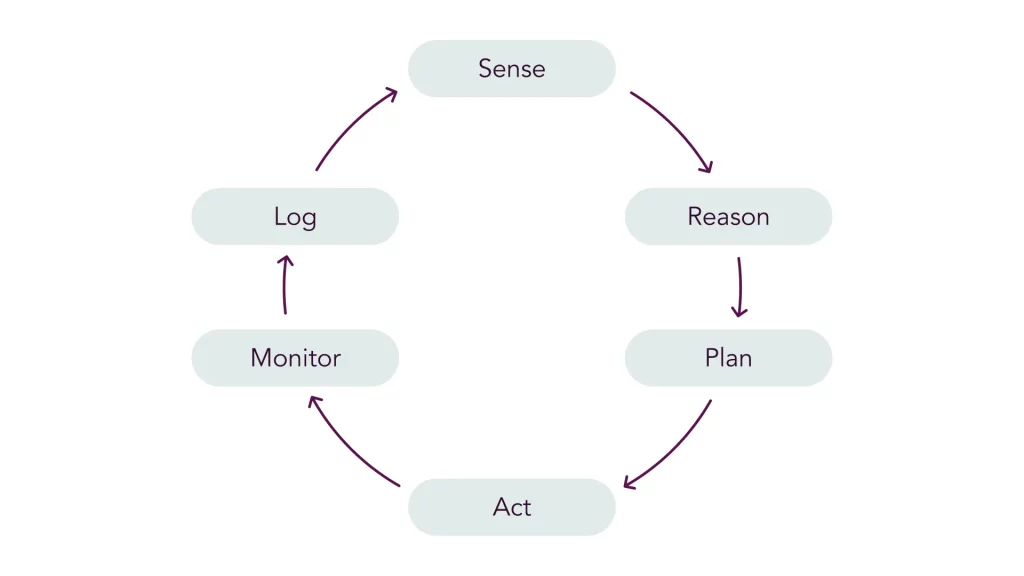
Agentic building operations adds a system of action on top of the data your EMCS already produces. Instead of a rule such as “run ventilation at 60% from 06:00 to 18:00”, an energy agent gets a goal such as “keep CO₂ below 800 ppm at minimum energy cost.” It then runs a continuous loop. It reads live meter and sensor data, weighs it against the goal, weather, occupancy and tariffs, and chooses an action. It executes that action through the BMS, observes the result and adjusts, every few minutes, across every building in the portfolio.
The BMS and EMCS stay in place as the trusted control layer and safety boundary. Agents work through them. For why the two complement each other rather than compete, see BMS vs agentic AI: why the best buildings use both.
| Traditional EMCS | EMCS with AI agents | |
| Core role | System of record and control | System of action |
| Logic | Fixed schedules and setpoints | Goal-directed, adapts continuously |
| Who acts | People read dashboards and make changes | Agents act; people set goals and supervise |
| Response to change | None until reprogrammed | Detects, decides, adjusts |
| Scale | Per building, per vendor | Portfolio-wide through a shared data model |
| Typical output | Reports and alarms | Savings delivered, faults routed as work orders |
What energy agents do in practice
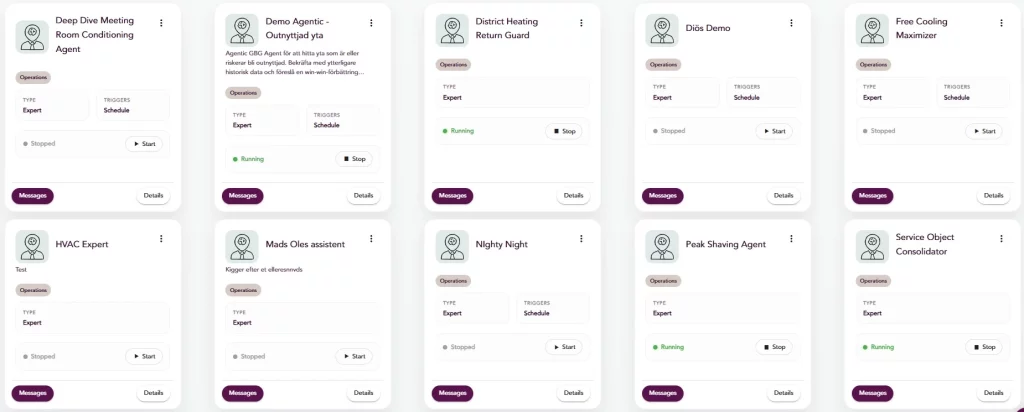
Energy is the most mature area of agentic building operations. Agents already in production handle five kinds of work:
Continuous HVAC optimization. They tune heating, cooling and ventilation against comfort limits, and use the building’s thermal mass to pre-heat or pre-cool when energy is cheaper.
Peak shaving and demand flexibility. They shift loads away from peaks that drive capacity charges and support flexible power and demand response programmes.
Fault-to-work-order automation. They spot energy-wasting faults such as simultaneous heating and cooling or stuck valves, verify them, and draft a work order with diagnostic context for the right technician. This is the step that turns predictive maintenance from a report into a repair.
Alarm triage. They deduplicate and suppress known noise so operators see a short, prioritized list.
Energy and ESG reporting. They assemble consumption and emissions figures from live data, so reporting under your ESG framework stays audit-ready instead of being rebuilt every quarter.
See the full catalog of ProptechOS agents, or the broader list of 10 building tasks AI agents can automate today.
What your EMCS needs to be agent-ready
Most buildings don’t need a new EMCS to benefit from agents. They need three conditions in place.
Connected systems. The BMS, meters and sensors must be reachable through APIs. Legacy protocols such as BACnet and Modbus, and closed vendor systems, can usually be bridged rather than replaced. See ProptechOS connectors.
A semantic data layer. A point named AHU-03_SAT_1 means nothing to software until it is mapped to a shared vocabulary. Open ontologies such as RealEstateCore let one energy agent work across many buildings and BMS brands without being rebuilt for each.
A permissions framework. You decide which systems agents may observe, which they may adjust, within what ranges, and which changes need human approval.
Onboarding used to mean months of point-mapping per building. Today much of it is agent-assisted. AI agent-ready buildings: onboarding explained walks through the process.
Keeping energy agents safe
Software that acts on physical plant needs layered controls, not trust. Each agent gets only the access its task requires. Agents start in suggest-only mode, and people approve each action until the agent has a track record. Hard limits on temperature bands, rates of change and schedule windows are enforced by the platform, and the BMS’s own safety logic remains the final backstop. Every decision is logged with its reasoning, and any agent can be paused or any change reversed instantly.
For the full framework, watch permission policies and guardrails for AI agents in real estate.
The business case
Lower energy costs. Research on conventional energy management systems has found building energy reductions of up to 16%, and up to 40% for lighting. Continuous agent-driven optimization goes further. Vasakronan cut energy use for heating and cooling by 36% with ProptechOS, and deployments on the platform average around 30% energy savings. Results depend on building type, data quality and how much autonomy agents are given.
Compliance as continuous operation. Tightening rules such as the EU’s EPBD and reporting obligations under the CSRD make energy performance a financial line item. Agents turn compliance from a periodic project into evidenced, day-to-day operation. That supports your building decarbonization roadmap and the path to net-zero energy buildings.
Asset value and tenant demand. ProptechOS research across more than 40,000 US offices found rental premiums of up to 37% for LEED-certified space. Occupiers reporting their own emissions increasingly favour buildings that can prove efficient operation.
More buildings per technician. Agents absorb high-frequency routine work, so skilled facility staff spend their time on judgment calls rather than setpoint changes.
How to evaluate an EMCS or agentic energy platform
Many products now call themselves AI-driven, but plenty are dashboards with a chatbot attached. Six questions help separate them. Can agents actually execute changes on live systems, and through what mechanism? Is the data model built on an open ontology, and who owns it if you leave? What do the permissions and audit features look like today, not on the roadmap? How long does onboarding take, and how much of it is automated? Can your team build or modify agents? Is there evidence of results at portfolio scale?
The vendor-neutral version of this checklist is in evaluating agentic AI platforms for commercial real estate.
Energy management with ProptechOS
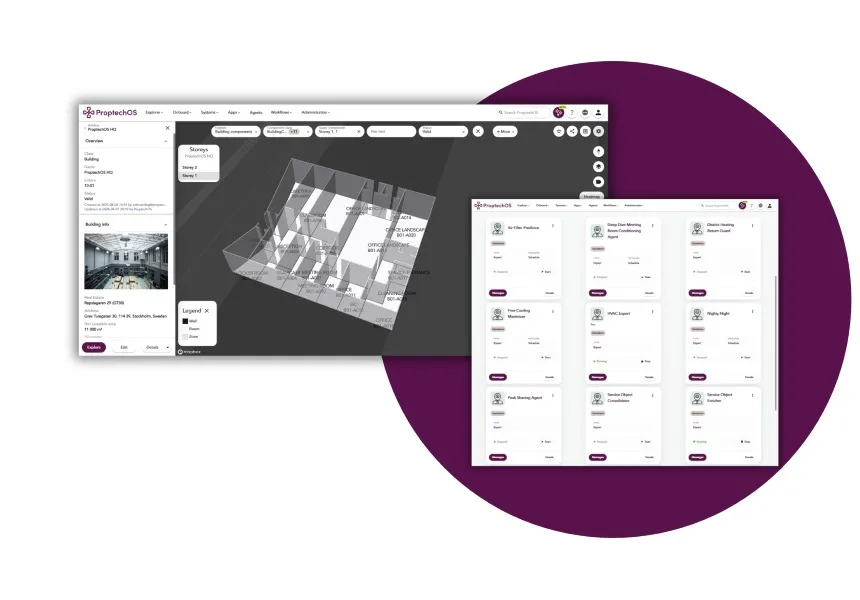
ProptechOS connects to your existing BMS, EMCS and meters, structures the data on the open RealEstateCore ontology, and runs a workforce of AI agents for energy optimization, fault-to-work-order automation, alarm triage and reporting. Every agent is governed by per-agent permissions, graduated autonomy and full audit logs. Your EMCS keeps doing what it does well, and the agents act on what it sees.
Explore the energy toolbox, see how ProptechOS works, or learn what an AI building operations platform is. When you’re ready, book a demo or start a free trial.
FAQ
What is an energy management control system?
An EMCS is the combination of meters, sensors, controllers and software that measures, monitors and controls a building’s energy use, mainly HVAC, lighting and electrical loads.
What is the difference between an EMCS and a BMS?
A BMS controls all major building systems. An EMCS focuses on energy measurement and control and is often a module within the BMS. Both are systems of record: they collect data and run fixed logic, while people make the operational decisions.
How do AI agents improve an energy management control system?
Agents use EMCS and BMS data to pursue goals such as minimum energy use at target comfort. They adjust setpoints and schedules continuously, shave demand peaks, and turn detected faults into work orders, all within human-defined permissions.
Do I need to replace my EMCS to use AI agents?
Usually not. Agents work through your existing BMS and EMCS. What they need is API connectivity, a semantic data layer such as RealEstateCore, and a permissions framework.
How much energy can agentic building operations save?
Conventional energy management systems have been shown to reduce building energy use by up to 16%. With continuous agent-driven optimization, ProptechOS deployments average around 30%, and Vasakronan achieved 36% for heating and cooling. Results vary by building and by the level of autonomy granted.

