
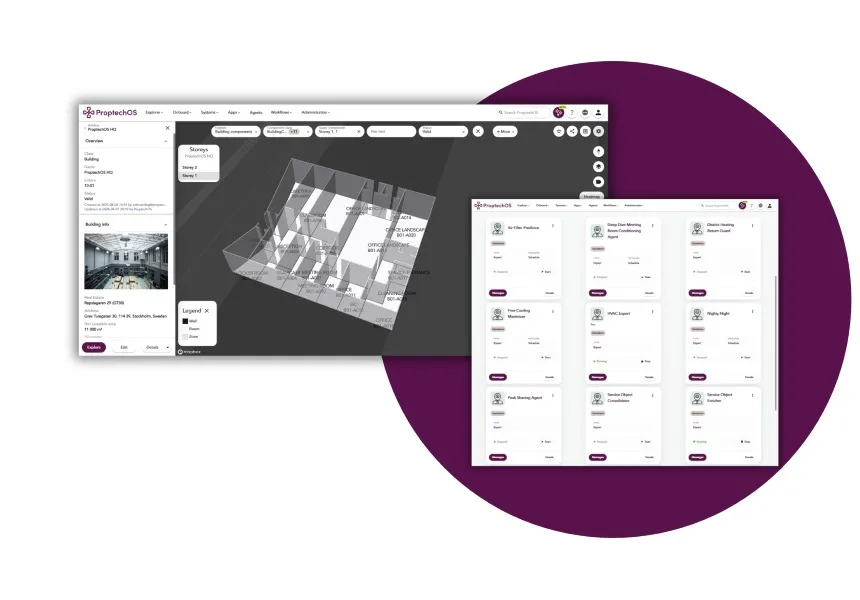
An AI building operations platform is software that autonomously runs the day-to-day operation of a commercial building. It sits on top of the building management system (BMS) — the system of record — and uses agentic AI to act on live building data: analyzing conditions, deciding what to adjust, and executing changes within defined guardrails, rather than only visualizing or alerting.
Put simply: the BMS is the system of record; the AI building operations platform is the system of action.
The term has emerged as buildings shift from being monitored to being operated by software. Traditional systems — the BMS and the underlying building automation system (BAS) — record data and run fixed schedules and rules. An AI building operations platform adds a layer that perceives, decides and acts continuously, turning a building’s own data into operational decisions without waiting for a person to read a dashboard. It’s the platform layer behind agentic building operations.
What makes a platform an AI building operations platform
Not every product with AI in a building qualifies. Five things separate a platform from a dashboard, an analytics report or a chatbot:
- It acts — it doesn’t just display. It closes the loop from insight to execution, making and carrying out operational changes rather than surfacing them for someone else to action.
- It runs on an agentic AI layer. Software agents plan and take multi-step actions toward a goal, rather than firing single if-this-then-that rules.
- Its autonomy is guardrailed. It operates inside human-set constraints, with clear override, escalation and an audit trail of every action.
- It’s interoperable by design. Built on an open building ontology, it works across vendors, equipment and portfolios instead of being locked to one BMS.
- It operates continuously, portfolio-wide. It runs day and night across many buildings, not as a one-off analytics project.
How it works
The platform reads from the systems already in the building — the BMS and BAS, IoT sensors, meters and external feeds like weather — and normalizes them through an open ontology so data means the same thing across every building. Its agents then perceive the current state, decide what to change against a goal, and act, staying inside guardrails and escalating anything outside them. A worked example of a single decision:
- Trigger: occupancy drops in a zone while HVAC keeps running to a fixed schedule.
- Action: the platform adjusts setpoints and ventilation to match the actual occupancy.
- Systems & data: BMS setpoints, occupancy sensors, energy meters, weather feed.
- Guardrail: stays within agreed comfort bands; flags anything outside them for human approval.
- Measure: energy use per zone, comfort complaints, override rate.
How it differs from a BMS, BAS, digital twin and AI copilot
The category is easiest to understand by what it is not. Each of these plays a different role, and the platform sits on top of them:
| System | Primary role | Acts on the building? | Relationship |
|---|---|---|---|
| AI building operations platform | System of action — autonomously operates the building | Yes, within guardrails | Sits on top of the BMS |
| BMS | System of record — monitors and controls equipment | Runs set rules and schedules; no autonomous decisioning | The platform’s foundation |
| BAS | Control layer — wires and actuates equipment | Rule- and schedule-based automation only | Feeds and receives from the BMS |
| Digital twin | Virtual model — simulates and visualizes | No — represents, doesn’t operate | A data source the platform can use |
| AI copilot / assistant | Advises a human — answers questions, suggests | No — the human still acts | A conversational layer, not an operator |
For a deeper side-by-side on the two most-confused categories, see BMS vs agentic AI platform. Interoperability across all of these depends on a shared data model — for ProptechOS, the open RealEstateCore ontology.
Frequently asked questions
Is a BMS an AI building operations platform?
No. A BMS is the system of record — it monitors equipment and runs fixed schedules and rules. An AI building operations platform sits on top of the BMS and adds autonomous, guardrailed decision-making and action.
Do I need one if I already have a BMS?
Yes, if the goal is autonomous operation. The platform complements the BMS rather than replacing it: the BMS keeps recording and controlling equipment, while the platform decides and acts on that data continuously.
How is it different from a digital twin?
A digital twin models and visualizes a building; it represents reality but doesn’t operate it. An AI building operations platform acts on the real building, and can use a digital twin as one of its data sources.
Is an AI copilot the same thing?
No. A copilot answers questions and suggests actions to a person, who then acts. An AI building operations platform takes the action itself, within guardrails.
What is an AI building operations platform built on?
An open building ontology that normalizes data across different systems and equipment, so the platform can operate consistently across vendors and portfolios. ProptechOS is built on the open RealEstateCore ontology.
Is it safe to let AI operate a building?
Autonomy is bounded. The platform acts only within human-set guardrails, escalates anything outside them, keeps a full audit trail, and leaves override in human hands.
Next: see how the pieces fit together in agentic building operations, or work through the buyer’s criteria in evaluating agentic AI platforms.

