
Definition
Agentic building operations is the practice of running buildings with autonomous AI agents that continuously perceive live building data, reason about operational goals — energy efficiency, comfort, uptime, compliance — and execute actions on building systems within permissions and guardrails defined by human operators.
The defining word is act. Conventional building software is a system of record: it collects data, displays dashboards, and raises alarms, while every actual change — a setpoint adjustment, a work order, a schedule override — is performed by a person. Agentic building operations adds a system of action on top of that record. Software agents close the loop between observing a condition and doing something about it, at a frequency and scale no operations team can match manually.
The term sits at the intersection of two established categories. From the smart buildings world it inherits the infrastructure: sensors, meters, building management systems, and structured data. From the field of agentic AI it inherits the operating model: autonomous agents that pursue goals, use tools, and coordinate with each other and with humans. Related terms you may encounter include autonomous building operations, intelligent building operations, and autonomous buildings — all describing the same shift from software that informs people to software that acts for them.
Three properties distinguish a genuinely agentic operation from conventional automation:
Goal-directed, not rule-bound. A BMS schedule says “run ventilation at 60% from 06:00 to 18:00.” An agent is given the goal — “maintain CO₂ below 800 ppm at minimum energy cost” — and works out the schedule itself, revising it as occupancy, weather, and electricity prices change.
Perceive–decide–act loops. Agents run continuously. They read telemetry, evaluate it against their goal, choose an action, execute it through an API or the BMS, observe the result, and adjust. The loop runs every few minutes, around the clock, across every building in a portfolio simultaneously.
Bounded autonomy. Agents act inside explicit human-defined limits: which systems they may touch, which ranges they may operate within, which decisions require approval. Autonomy is granted progressively as agents demonstrate reliability — not assumed from day one.
How does agentic building operations work?
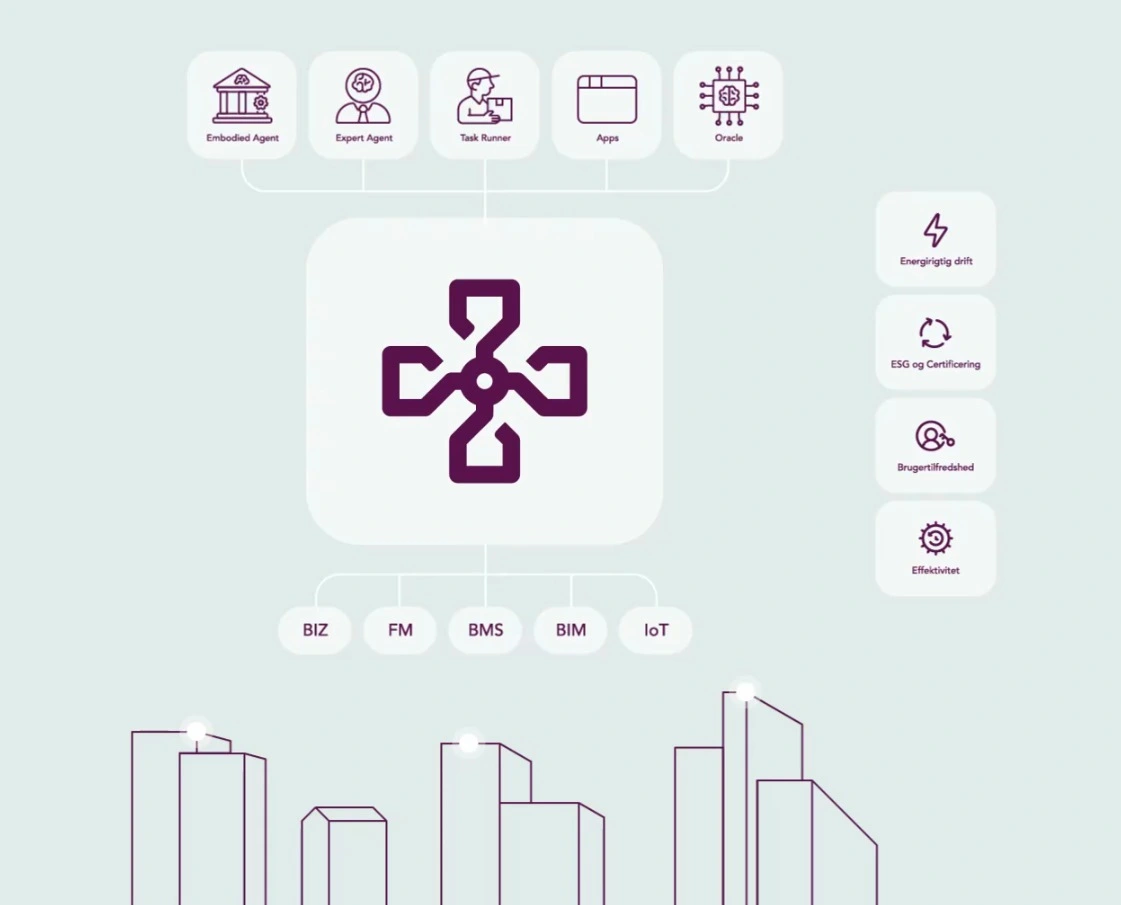
An agentic operation is a stack of four layers. Most buildings already have the bottom one; the value comes from adding the top three.
1. Connectivity. Agents need access to the building’s nervous system: the BMS, energy meters, IoT sensors, weather feeds, occupancy data, and business systems such as work order management. This is integration work, and it is where legacy protocols (BACnet, Modbus, proprietary vendor systems) get bridged into modern APIs.
2. Semantics. Raw building data is unintelligible to software. A data point named AHU-03_SAT_1 means nothing until it is mapped to a shared vocabulary that says: this is a supply air temperature sensor, on air handling unit 3, serving floors 2–4 of building A. Open ontologies — RealEstateCore, Brick Schema — provide that vocabulary. The semantic layer is what lets one agent work across many buildings without being reprogrammed for each: it reasons about concepts, not point names.
3. Agents. The agent layer hosts the workforce: individual agents specialized for tasks such as energy optimization, alarm triage, fault detection, or work order drafting. Each agent has a goal, a set of tools (APIs it may call), a scope (which buildings and systems), and a permission level. Agents can also coordinate — a fault-detection agent handing its finding to a work order agent — forming multi-agent workflows.
4. Supervision. The top layer is human. Operators define goals and guardrails, review agent suggestions, approve consequential actions, audit logs, and expand or restrict autonomy based on performance. In mature deployments the facility manager’s day shifts from performing hundreds of routine actions to supervising the agents that perform them — a role change significant enough that some teams now describe the position as a chief of agents.
How is it different from a BMS or building automation?
The most common misconception is that agentic operations replaces the building management system. It does not — it changes what the BMS is for. The BMS remains the trusted control layer and the ultimate safety boundary; agents work through it. What changes is who makes the decisions the BMS carries out. The comparison below also covers building automation systems (BAS) and analytics or fault detection (FDD) platforms, the two categories agentic operations is most often confused with.
| BMS / BAS | Analytics & FDD platforms | Agentic building operations | |
|---|---|---|---|
| Core role | System of record and control | System of insight | System of action |
| Logic | Fixed rules and schedules | Statistical models flag anomalies | Goal-directed reasoning, adapts continuously |
| Who acts | Humans configure; system executes fixed logic | Humans read reports and act | Agents act; humans supervise and approve |
| Response to change | None until reprogrammed | Detects and reports | Detects, decides, and adjusts |
| Scale | Per building, per vendor | Portfolio reporting | Portfolio-wide action through a semantic layer |
| Typical outcome | Stable baseline operation | A list of findings, often unactioned | Findings closed automatically or routed as work orders |
A useful mental model: analytics platforms shortened the distance between a problem and knowing about it. Agentic operations shortens the distance between knowing and fixing. Industry research has long observed that most FDD findings are never acted on because the acting is manual — the agent layer is what removes that bottleneck. For a deeper treatment of why the two systems complement rather than compete, see BMS vs agentic AI: why the best buildings use both.
What do building AI agents actually do today?
Agentic building operations is not a future concept — agents are in production on commercial portfolios now. The current generation clusters around five task families:
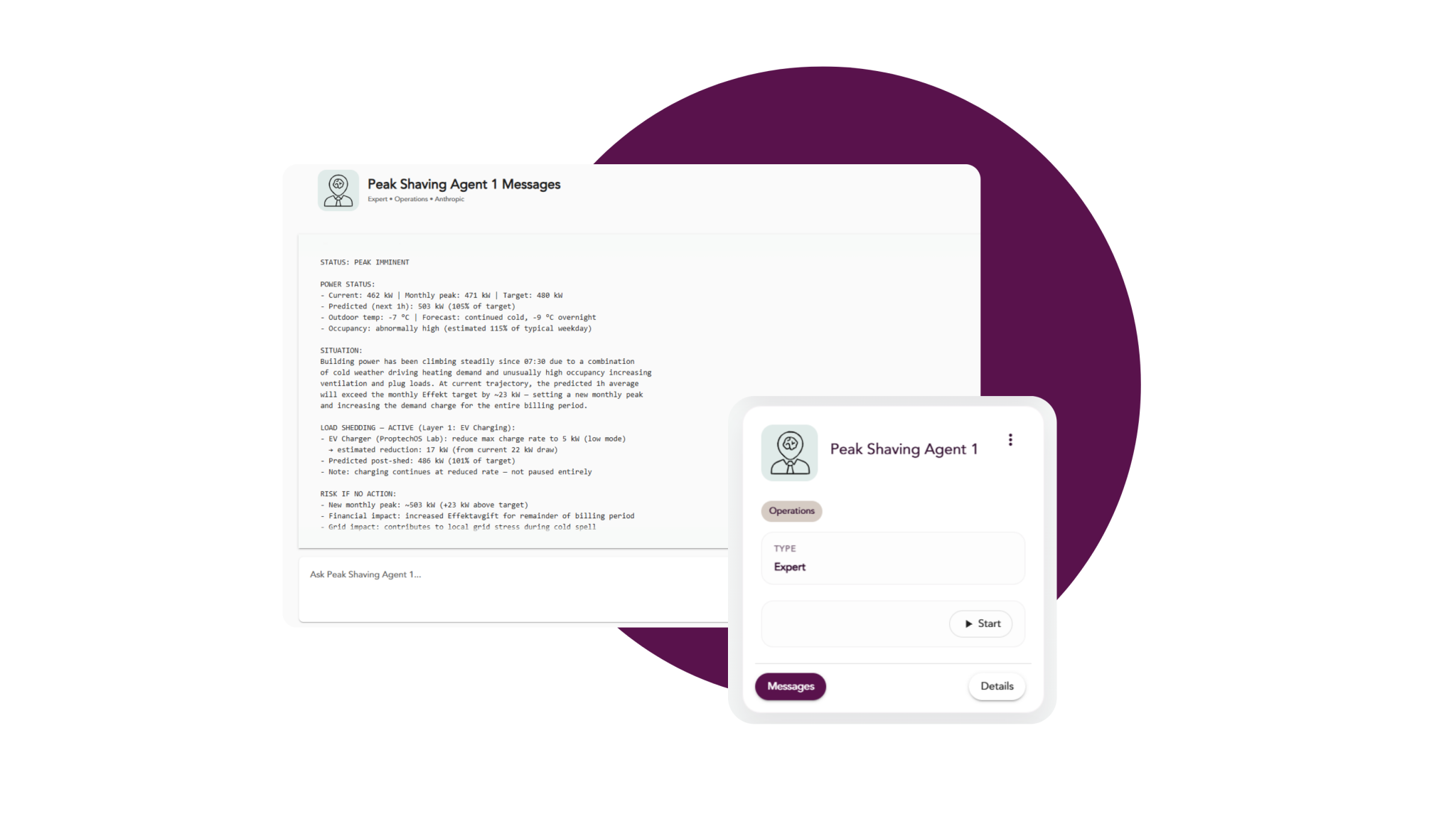
Energy optimization agents continuously tune heating, cooling, and ventilation against comfort constraints, exploit thermal mass to pre-heat or pre-cool when energy is cheap, and shave demand peaks that drive capacity charges. This is the most mature family, with documented savings typically in the 10–36% range.
Alarm triage agents address alarm fatigue — the thousands of BMS alarms per month of which only a fraction matter. Agents classify, deduplicate, suppress known noise, and escalate the genuinely urgent, turning an unreadable alarm feed into a short prioritized list.
Fault detection and work order agents identify degrading equipment from telemetry patterns, verify the fault, draft a work order with diagnostic context attached, and route it to the right technician — closing the insight-to-action gap that stand-alone FDD tools leave open.
Onboarding and data quality agents do the unglamorous work that makes everything else possible: discovering data points, proposing semantic mappings to the ontology, flagging sensor drift and gaps. They compress building onboarding from months of consulting work to days.
Reporting and compliance agents assemble energy, ESG, and regulatory reports from live data instead of quarterly spreadsheet archaeology, keeping figures continuously audit-ready.
For a task-level breakdown with examples, see 10 building tasks AI agents can automate today, and for a real deployment story, the Locum case study on AI agents in Stockholm’s hospitals.
What does a building need to become agent-ready?
Agent-ready describes a building whose data and systems are prepared for agents to operate on. It is the practical prerequisite for everything in this guide, and it comes down to three conditions:
Connected systems. The BMS, meters, and key operational systems are reachable through APIs rather than locked behind on-premise, vendor-sealed installations. Full replacement is rarely needed — most legacy systems can be bridged.
A semantic data layer. Every relevant data point is mapped to a shared ontology so agents understand what they are looking at. This is the step most often underestimated, and the reason open standards matter: an agent built against RealEstateCore concepts works on any RealEstateCore-modeled building, which is what makes agentic operations portable across a portfolio and across vendors.
A permissions framework. Before any agent acts, the organization decides what acting means: which systems are observable, which are adjustable, within what ranges, and which changes require a human click. Agent-readiness is as much governance as it is plumbing.
Onboarding used to be the expensive part of smart building projects — months of point-mapping consultancy per building. It is now substantially agent-assisted: discovery and mapping agents propose the semantic model and humans verify it. The practical guide to this process is AI agent-ready buildings: onboarding explained.
How do permissions and guardrails keep agents safe?
The reasonable first question about software that acts on physical buildings is: what stops it from acting badly? Mature agentic platforms answer with layered controls rather than trust:
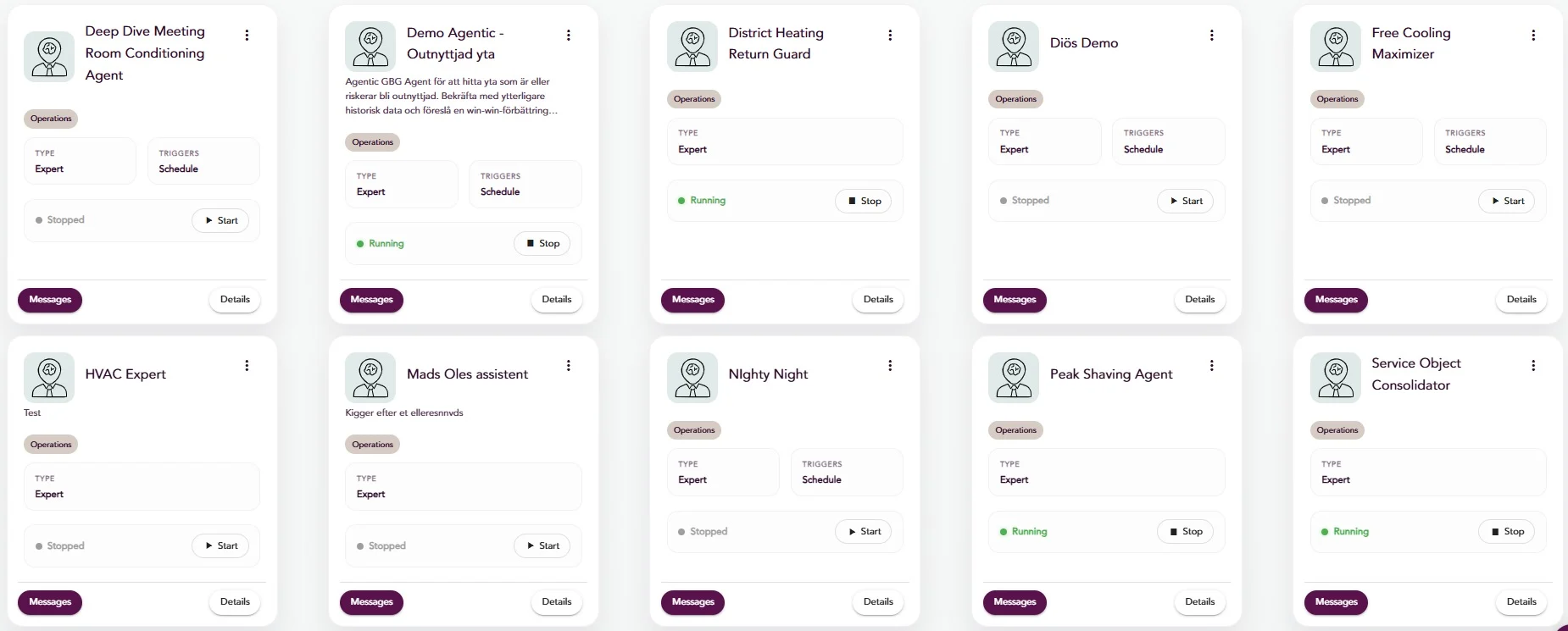
Scoped permissions per agent. Each agent is granted the minimum access its task requires — an energy agent may adjust setpoints within a defined band on specific systems and nothing else. Permissions are explicit, inspectable, and revocable.
Graduated autonomy. Agents typically launch in observe or suggest-only mode: they recommend actions and a human approves each one. As the track record accumulates, operators promote specific action types to autonomous execution. Autonomy is earned per task, not granted wholesale.
Bounded actions and safe ranges. Even autonomous actions run inside hard limits — temperature bands, rate-of-change caps, schedule windows — enforced at the platform level, with the BMS’s own safety logic remaining the final backstop.
Full auditability and instant override. Every observation, decision, and action is logged with its reasoning. Operators can pause any agent, revert any change, and review exactly what happened and why.
Governance is where agentic operations succeeds or fails organizationally, which is why it deserves as much design attention as the agents themselves. We cover the framework in depth in Permission policies and guardrails for AI agents in real estate.
Who is agentic building operations for?
Commercial property owners and asset managers adopt it to protect net operating income and asset value: energy is typically the largest controllable operating cost, and regulatory pressure (EPBD in Europe, local ordinances like New York’s Local Law 97) is turning building performance into a financial line item. Agents convert those obligations from periodic projects into continuous, evidenced operation.
Facility management teams and FM providers adopt it to escape the reactive trap — the alarm floods, the ticket backlogs, the firefighting that crowds out preventive work. Agents absorb the high-frequency routine so skilled staff, an increasingly scarce resource, spend their hours on judgment work. For service providers, agents are also a margin story: more buildings served per technician.
Portfolio operators with mixed building stock — offices, residential, healthcare, logistics — benefit most from the semantic-layer approach, because one agent workforce can run heterogeneous buildings and BMS brands without per-site custom integration.
Who it is not for (yet): a single small building with a modern, well-tuned BMS and an attentive operator will see modest gains relative to the onboarding effort. The economics strengthen with portfolio size, building complexity, energy intensity, and staffing pressure.
How do you evaluate an agentic building operations platform?
The category is young and the label is being applied loosely — some products marketed as agentic are analytics dashboards with a chatbot attached. Six questions separate genuine agentic platforms from rebranded monitoring:
1. Can agents act, and through what mechanism? Ask for a live demonstration of an agent executing a change on a real system — not a recommendation appearing on a dashboard. Ask what write-access looks like technically.
2. Is the data layer built on an open ontology? Platforms built on open standards (RealEstateCore, Brick) keep your semantic model portable; proprietary data models re-create the vendor lock-in that plagued the BMS era. Ask who owns the model if you leave.
3. What does the permissions and audit model look like? Per-agent scopes, graduated autonomy, action logs with reasoning, one-click override. If governance features are roadmap items, the platform is not production-ready for autonomous action.
4. How fast is onboarding, and how much of it is agent-assisted? The honest range today runs from days to a few weeks for connected buildings. Quotes measured in quarters signal manual integration under the hood.
5. Can you build and modify agents yourself? A closed set of vendor-defined agents caps the value. Look for the ability to define new agents, adjust goals, and integrate your own systems — agentic operations should compound with your team’s ideas.
6. What evidence exists at portfolio scale? Reference customers running agents across many buildings in production, with named outcomes, beat pilot anecdotes every time.
We maintain a vendor-neutral walkthrough of this checklist, including how to score answers, in Evaluating agentic AI platforms for commercial real estate.
Agentic building operations on ProptechOS
ProptechOS is a building operating system built for exactly this operating model. It connects to your existing BMS and building systems, structures everything on the open RealEstateCore ontology — which our team co-created and maintains — and hosts a growing workforce of AI agents for energy optimization, alarm triage, fault-to-work-order automation, onboarding, and reporting, all governed by per-agent permissions, graduated autonomy, and full audit logs.
Buildings onboard in days to weeks, not quarters, with agents doing most of the mapping work. And because the semantic layer is an open standard, your building model remains yours. You can explore the agent catalog, see how the platform works, or watch real deployments in the agentic proptech webinar series.
