
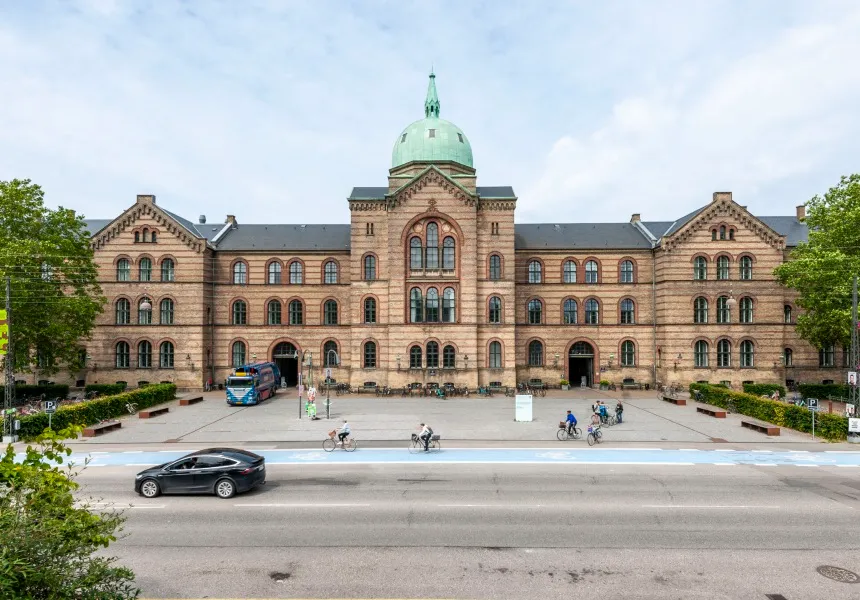
Lars Kristensen manages energy across one of Europe’s largest university campuses. With a two-person team, buildings dating back to 1470, and a million square metres to look after — he’s using AI to increase capacity and improve the quality of energy work across the portfolio.
The University of Copenhagen spans four campuses, hundreds of buildings, and roughly 550 years of architectural history. The oldest structures date back to the 1470s. The newest were completed in 2024. Somewhere in between — navigating the complexity of all of it — is a two-person energy team responsible for consumption, efficiency, and cost across the entire portfolio.
Lars Kristensen is one of those two people. As Energy Manager, he oversees the energy management system, initiates efficiency projects, and even checks all invoices concerning supply of energy (electricity, heating, cooling, water, gas etc). It’s a broad mandate for a small team — and it’s exactly the kind of environment where AI can make a real difference. He shares his experiences in his role at the university, but his views don’t necessarily represent the official policy or strategy of the University of Copenhagen.
The real bottleneck isn’t technology
When you ask Lars about the biggest barriers to working with data at the university, his answer doesn’t start with systems or software. It starts with people.
“In general, most problems we have are related to organisational issues. The technical solutions are available. But people and systems are not that used to sharing data. They work in silos.”
— Lars Kristensen, Energy Manager at the University of Copenhagen

The university’s energy data doesn’t live in one place. It’s spread across building management systems, energy management systems, facility management tools, and more — each with its own custodians, traditions, and access policies. Getting data to flow between them means navigating not just APIs, but organisational politics, hierarchies, and habits built up over decades.
And because the energy team is “low in the hierarchical structure,” as Lars puts it, pushing for change means decisions have to travel through many layers before anything happens. Running the ProptechOS project as a pilot has been fast. Getting IT involved for an enterprise-scale rollout is, by Lars’s own admission, “much slower and longer.”
Where AI is already delivering
Despite the organisational complexity, the impact has been immediate in Lars’s daily work. Before ProptechOS, analysing heat consumption against outdoor temperature meant regression analysis in Excel — Power Query formulas, manual coding, slow iteration. It worked, but it didn’t scale across a portfolio this size, and it required coding skills that aren’t universal in the organisation.
Now, Lars describes a fundamentally different workflow: using natural language to build tools that would previously have taken specialist programming skills.
“I can, with my own words, create code. Even if you just miss a comma in the code, it’s not working. Now I can just write in my own words that I want something to work differently. I don’t need to go through strange code to find exactly where the problem is.”
— Lars Kristensen
He sees this as something bigger than just convenience. For experienced professionals who carry deep domain knowledge but aren’t software developers, AI-powered tools offer something he half-jokingly calls “rehabilitation” — the ability to finally act on decades of expertise without a coding bottleneck.
The practical results are tangible. Lars estimates that AI tools have significantly increased his effective capacity — enabling him to cover for a colleague on maternity leave and take on a new CSRD emissions reporting task alongside his core energy management role.
The case for cautious autonomy
When it comes to AI agents — software that doesn’t just analyse but acts — Lars is thoughtful rather than hesitant. The university has a clear agreement in place: no autonomous agents making direct changes to building systems at this stage.
“There is a fear in the organisation for leaving changes to third parties. Historically, there is holding back. The next step won’t be autonomous buildings — it will be agents with humans in the loop, where we get optimised action proposals that are initiated by the maintenance organisation.”
— Lars Kristensen
But Lars doesn’t see this as a permanent ceiling — more as a sensible sequence. He already sees clear use cases for lighter-touch agents: alarm systems that automatically route alerts to the right vendor, invoice verification that automates the tedious manual checking he does today, and predictive maintenance proposals that a human signs off on before execution.
Overcoming the “Can you rely on it?” question
One of the sharpest observations Lars makes is about how scepticism spreads in organisations. Everyone has had the experience of asking a chatbot something and getting a strange answer. That single experience, he says, often becomes the argument against all AI adoption.
His counter-argument is direct: the quality of what comes out depends on what goes in. Poor data structure, vague prompts, information crammed into wrong formats — these produce poor results regardless of how sophisticated the AI is. The solution isn’t to dismiss the technology. It’s to engage with it seriously enough to understand where the real challenges lie.
“You have to work with it in order to understand the dangers and the difficulties and the possibilities. You can’t just say “can you rely on it?” — that tells me you haven’t tried it.”
— Lars Kristensen
The risk of doing too much
Interestingly, Lars’s concern isn’t that AI will underwhelm — it’s that it might overwhelm. When the barrier to building tools drops dramatically, the temptation is to build everything at once. He warns against creating “a lot of noise” simply because the capability exists.
His advice: focus on what delivers real impact and resist the pull of building things just because you can. He applies this thinking to the data strategy too — rather than trying to integrate every system, start with what matters most for the core task (in his case, energy efficiency) and let the scope evolve organically.
Advice for other organisations: just start
Asked what he’d tell other campus organisations still on the fence, Lars’s answer is straightforward: “Move on.” But he adds nuance that reflects real operational experience.
First, create distinct environments: a development area for experimenting, a proof-of-concept area for validation, and a production area for live use. Don’t try to go from idea to production in one step.
Second, treat it as a cycle, not a line. Borrowing from the PDCA (Plan-Do-Check-Act) framework common in energy management, Lars stresses that AI tools need continuous iteration — you’ll always need to bring them back into the development pool.
Third, pair the eager with the cautious. Spreading adoption works better when enthusiastic early adopters partner with more hesitant colleagues, rather than pushing from the top or leaving sceptics behind.
Copenhagen University is still early in its AI journey — Lars is clear-eyed about that. The organisational challenges haven’t disappeared. The full integration of live data is still ahead. But the trajectory is unmistakable: a two-person team is already seeing what’s possible, and the practical benefits of AI in building energy management are becoming increasingly tangible — even in the experimentation phase.
As Lars puts it: “I know we can make solutions on most issues. Maybe not solve them completely — but we can clarify what the steps are to solve them, to an extent which has been difficult before.”
For a university managing buildings that span half a millennium, that’s a pretty good start.

