

An environmental control system (ECS) monitors and regulates a building’s indoor conditions: temperature, humidity, ventilation and air quality. A conventional ECS keeps those conditions within fixed ranges using schedules and rules. In agentic building operations, AI agents take the same sensor data and pursue goals, such as keeping CO₂ below target at the lowest possible energy cost. They adjust ventilation, heating and cooling continuously within limits your team sets.
This guide explains what an ECS does, why indoor environment matters for occupants and for ESG, and how agents resolve the trade-off every ECS faces: healthy air costs energy.
What is an environmental control system?
An ECS is the part of a building’s technical systems responsible for the indoor climate. It works across four areas.
Temperature. It keeps spaces within a comfort band as occupancy, solar gain and outdoor conditions change.
Humidity. It holds relative humidity in a healthy range, commonly cited as 40–60%, which limits both dryness and mould growth.
Ventilation. It brings in outdoor air and removes stale air to dilute CO₂ and other contaminants.
Air quality. It filters particulates, dust and allergens and monitors pollutants such as PM2.5 and VOCs.
In commercial buildings, the ECS rarely stands alone. It is usually a subsystem of the building management system (BMS) or building automation system (BAS). It shares HVAC equipment with the energy management control system, which is why indoor climate and energy decisions are so tightly linked.
Why the indoor environment matters
People spend around 90% of their time indoors, according to the U.S. EPA. Poor indoor environments have measurable effects. Sick building syndrome links inadequate ventilation and malfunctioning HVAC to symptoms from eye and skin irritation to headaches and respiratory complaints. Research from Harvard has found that poorer office air quality is associated with slower, less accurate cognitive performance.
For property owners, this is also an ESG issue. Occupant health is the “S” that tenants, investors and certification schemes increasingly ask landlords to evidence, alongside energy and emissions. A well-run indoor environment supports green building design, certification under schemes such as LEED and BREEAM, and a stronger tenant experience.
The ECS trade-off: healthy air vs energy use
Every ECS faces the same tension. More outdoor air improves air quality, but that air has to be heated, cooled and dehumidified, which costs energy. Less ventilation saves energy but risks stuffy, CO₂-heavy spaces.
A conventional ECS resolves this tension with fixed logic: ventilation rates per schedule, setpoints per zone, alarms when a threshold is crossed. Fixed logic ends up erring in one direction or the other. One Bryant Park in New York, the first U.S. skyscraper to reach LEED Platinum, is a well-documented example. Its intensive office use led to overventilation and higher energy consumption, and the management team had to monitor air quality and energy closely to protect performance.
That kind of continuous balancing is exactly where people run out of hours and agents do not.
How AI agents run the indoor environment
An agent working on the indoor environment is given a goal rather than a schedule, for example “keep CO₂ below 800 ppm and temperature within 21–23 °C at minimum energy cost.” It then runs a continuous loop. It reads live data from CO₂, temperature, humidity and occupancy sensors. It weighs that data against the goal, the weather forecast and energy prices, and chooses an action. It executes the action through the BMS, checks the result, and adjusts. The loop repeats every few minutes, in every zone, across the portfolio.
The BMS remains the control layer and safety boundary; agents act through it. See BMS vs agentic AI: why the best buildings use both.
| Conventional ECS | ECS with AI agents | |
| Core role | System of record and control | System of action |
| Ventilation logic | Fixed rates and schedules | Demand-driven, adjusted continuously |
| Health vs energy | Resolved once, at commissioning | Rebalanced every few minutes |
| Response to complaints | Ticket, manual investigation | Agent checks the data, adjusts or routes a work order |
| Scale | Per zone, per building | Portfolio-wide through a shared data model |
| Evidence for ESG | Periodic manual exports | Continuous, audit-ready indoor climate records |
What indoor environment agents do in practice
Demand-controlled ventilation. Agents match outdoor air to real occupancy rather than timetables. They use CO₂ and occupancy data to ventilate hard when rooms fill up and to back off when they empty.
Comfort optimization. Agents hold temperature within comfort bands while pre-heating or pre-cooling when energy is cheaper.
Humidity and mould risk. Agents watch for sustained humidity outside the healthy range and act before it becomes a building-fabric or health problem.
Fault detection. Agents catch the equipment problems behind poor indoor climate, such as stuck dampers, clogged filters, drifting sensors and simultaneous heating and cooling. They then draft a work order with the evidence attached.
Complaint handling. When an occupant reports a room is too warm, an agent can check that zone’s data, correct the setpoint if the fix is within its permissions, or route the issue to a technician with context.
Indoor climate reporting. Agents compile indoor environment records for certifications and sustainability and compliance reporting from live data.
For more examples, see 10 building tasks AI agents can automate today. To see agents managing demanding indoor environments, read the Locum case study on AI agents in Stockholm’s hospitals.
What stays outside the agents’ reach: life safety
In a fire, ECS and ventilation equipment work with smoke control systems to keep escape routes clear. Those functions belong to dedicated, certified life-safety systems and their own control logic. In a well-governed agentic setup, agents may observe life-safety status, for example to pause optimization during an alarm. They are not given permission to override smoke control, fire dampers or alarm sequences.
This is part of a broader principle. Each agent gets only the access its task requires, starts in suggest-only mode, and acts within hard limits. The BMS’s own safety logic stays in place as the final backstop. For the full framework, see permission policies and guardrails for AI agents in real estate.
What your ECS needs to be agent-ready
Three conditions matter more than the age of your equipment.
Connected systems. The BMS, HVAC controllers and indoor climate sensors must be reachable through APIs; legacy protocols can usually be bridged through connectors.
A semantic data layer. A shared vocabulary such as RealEstateCore records that a sensor measures CO₂, in a meeting room, served by a specific air handling unit. That is what lets one ventilation agent work across many buildings.
Permissions. You decide which systems agents may adjust, within what ranges, and what needs human approval.
AI agent-ready buildings: onboarding explained covers the process step by step.
The business case
Healthier, more productive spaces. Continuous control keeps CO₂, temperature and humidity in range when occupancy peaks, which is precisely when fixed schedules fall behind.
Lower energy use without sacrificing air quality. Agents ventilate only as much as conditions require. Across ProptechOS deployments, continuous optimization averages around 30% energy savings. Vasakronan cut heating and cooling energy use by 36%. Results depend on building type, data quality and the level of autonomy granted.
Evidence for certification and ESG. Indoor climate becomes a continuous, auditable record rather than a snapshot. That strengthens certification submissions and reporting under your ESG framework.
Fewer complaints, faster fixes. Agents resolve routine comfort issues directly and route the rest with diagnostics attached, which frees facility teams for work that needs judgment. See operational efficiency and building optimization.
Indoor environment management with ProptechOS
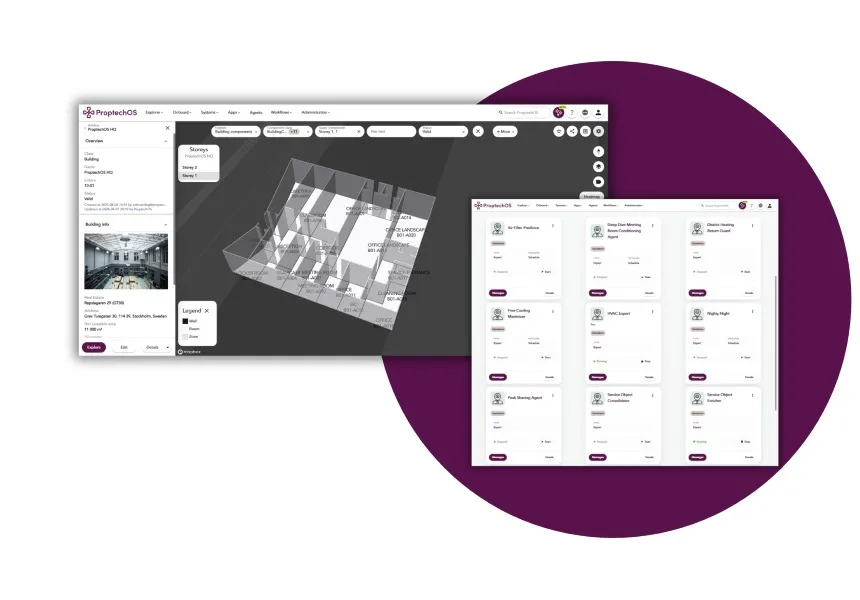
ProptechOS connects to your existing BMS, BAS and IoT sensors and structures the data on the open RealEstateCore ontology, so your building model stays yours. On top of that data, it runs AI agents for ventilation and comfort optimization, fault-to-work-order automation, alarm triage and reporting. Every agent is governed by scoped permissions, graduated autonomy and full audit logs.
See how ProptechOS works, learn about combining building and workplace data, or book a demo. You can also start a free trial.
FAQ
What is an environmental control system?
An environmental control system (ECS) monitors and regulates indoor conditions in a building, including temperature, humidity, ventilation and air quality, usually as part of the BMS or BAS.
What is the difference between an ECS and a BMS?
The BMS controls a building’s major technical systems. The ECS is the part focused on indoor climate. Both traditionally run fixed rules and schedules, with people making the operational decisions.
How do AI agents improve indoor air quality?
Agents adjust ventilation to real-time CO₂ and occupancy instead of fixed schedules. They keep air quality within target when spaces are busy and reduce ventilation energy when they are not. They also detect faults such as stuck dampers that degrade air quality.
Can AI agents control fire and smoke systems?
They should not. Life-safety systems keep their own certified control logic. In a well-governed setup, agents may observe alarm status but have no permission to override smoke control, fire dampers or alarm sequences.
Does better ventilation always mean higher energy costs?
Not when ventilation follows demand. Continuously matching outdoor air to actual occupancy avoids overventilating empty spaces. That is how agent-run buildings improve air quality and reduce energy use at the same time.

