
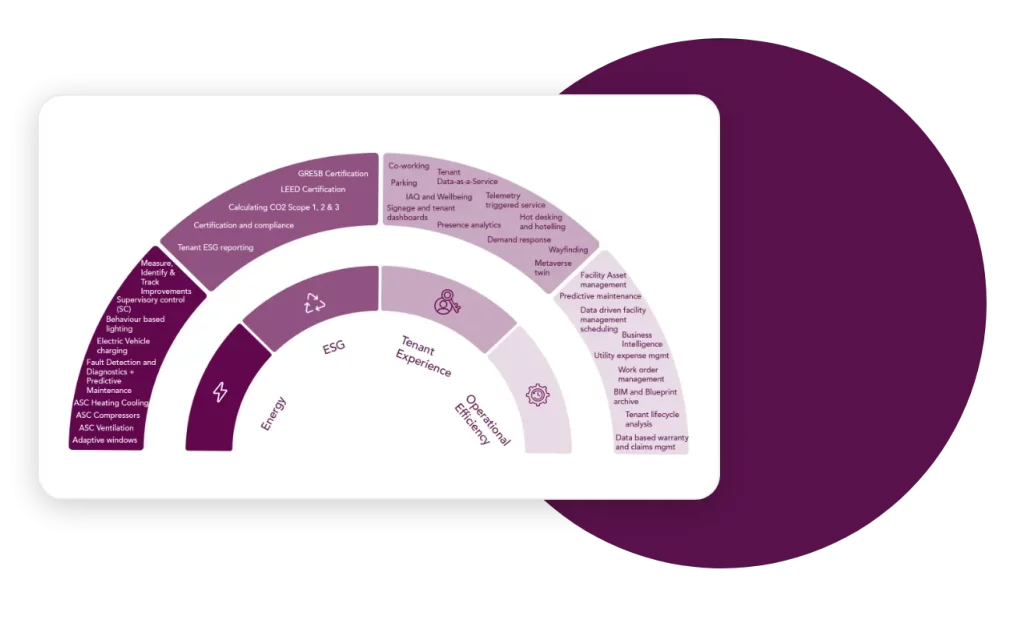
You can’t build the future on a stack of silos
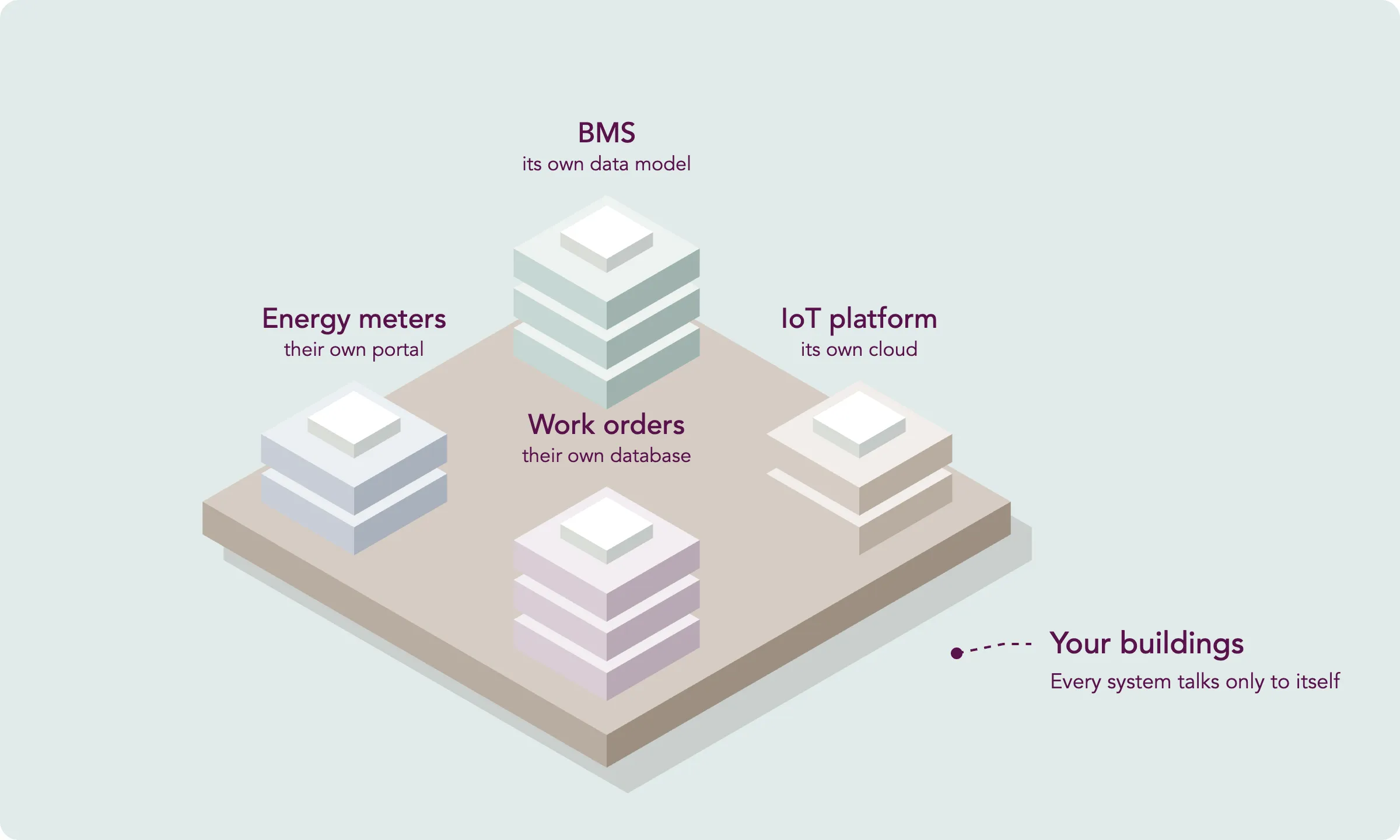
Every building you inherit comes with its own building management system (BMS), its own Internet of Things (IoT) point tools, and its own proprietary data model. None of them talk to each other, so every new capability turns into a custom integration project — and the data you’d need to do anything intelligent stays locked inside vendors with no interest in handing it over.
That leaves you in a hard spot. The business wants AI, analytics, and automation across the portfolio, but the foundation underneath is a patchwork of closed systems. Data ownership and residency are open questions. And every point tool you add to plug a gap is one more silo you’ll have to integrate around later.
What’s missing is a foundation built to be built on.
From closed silos to an open platform
A BMS and a stack of point tools are each a system of record — for their own slice, in their own format, behind their own walls. What none of them give you is a common data layer across every building and vendor, or a platform you can extend, govern, and run intelligence on top of.
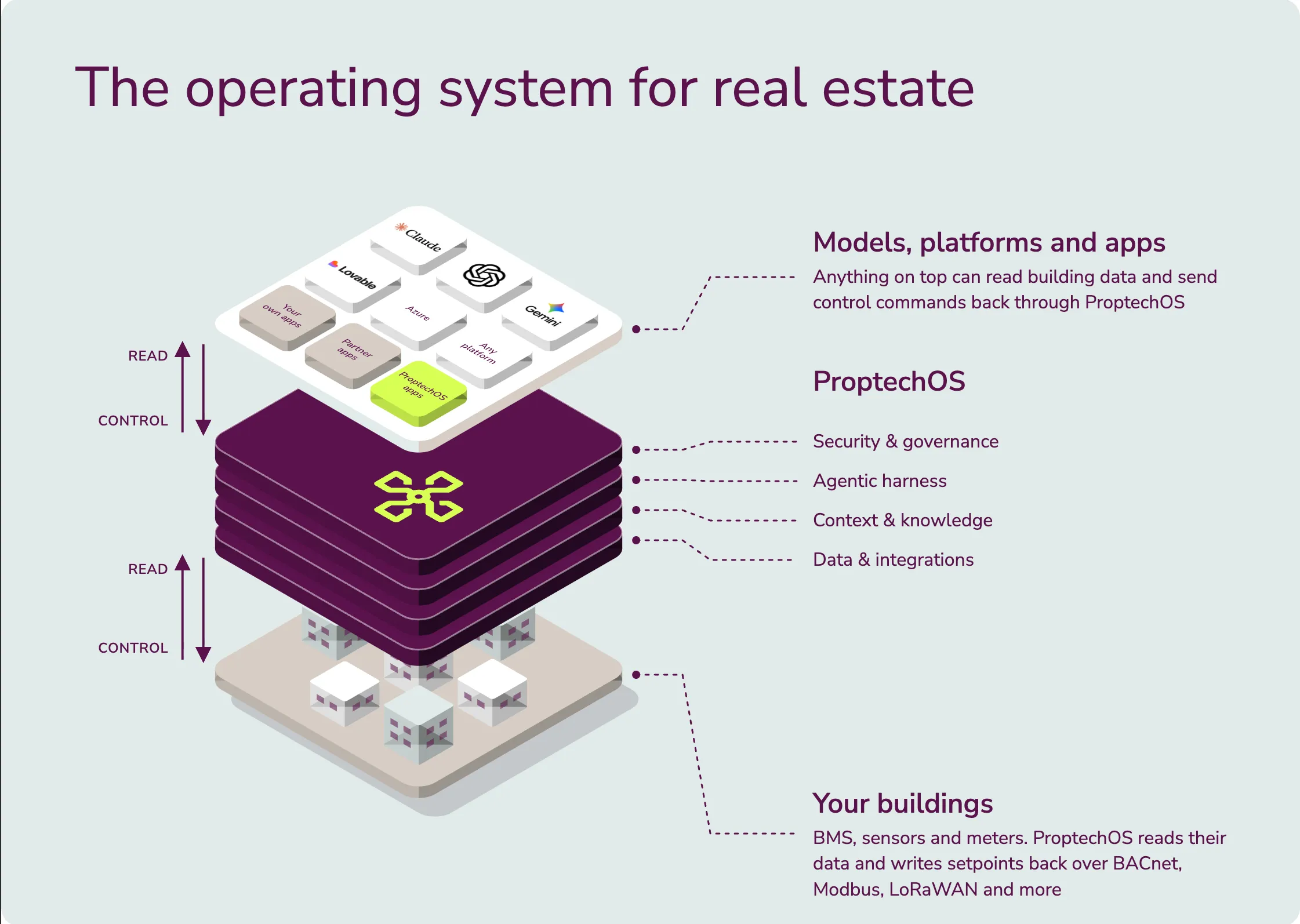
That’s the gap ProptechOS closes. We normalise data from any BMS or IoT source onto the open RealEstateCore ontology — a shared, standardised model for the built environment — and expose it through an API-first platform. AI agents run on that layer, and so can anything your team wants to build. It’s a foundation for the whole estate.
One platform to build on, for every team.
Build on an open platform your whole business can use
Open ontology. ProptechOS is built on RealEstateCore, an open standard data model for real estate — so every building is described in a consistent, portable, machine-readable language that any system or agent can read.
API-first by design. Everything the platform knows is available through APIs, so your team can integrate systems, pull data into your own tools, and build applications on top on your own timeline.
Connect any source. Any BMS, any IoT system, any vendor — ProptechOS normalises them onto one layer, turning a fragmented estate into a single, queryable foundation.
AI agents you can govern. Agents run on your normalised data under guardrails you define. They take on repetitive work for teams across the business, and you decide what each agent can see and do.
Best of breed for every role. Facility, energy, and asset teams each use the agents and apps that fit their work, all on the same data. ProptechOS becomes the place the business goes first when it needs a new capability.
Your data, owned by you. Because the model is open and API-first, your building data stays portable and under your control.
No rip and replace. It works on top of what you already run.
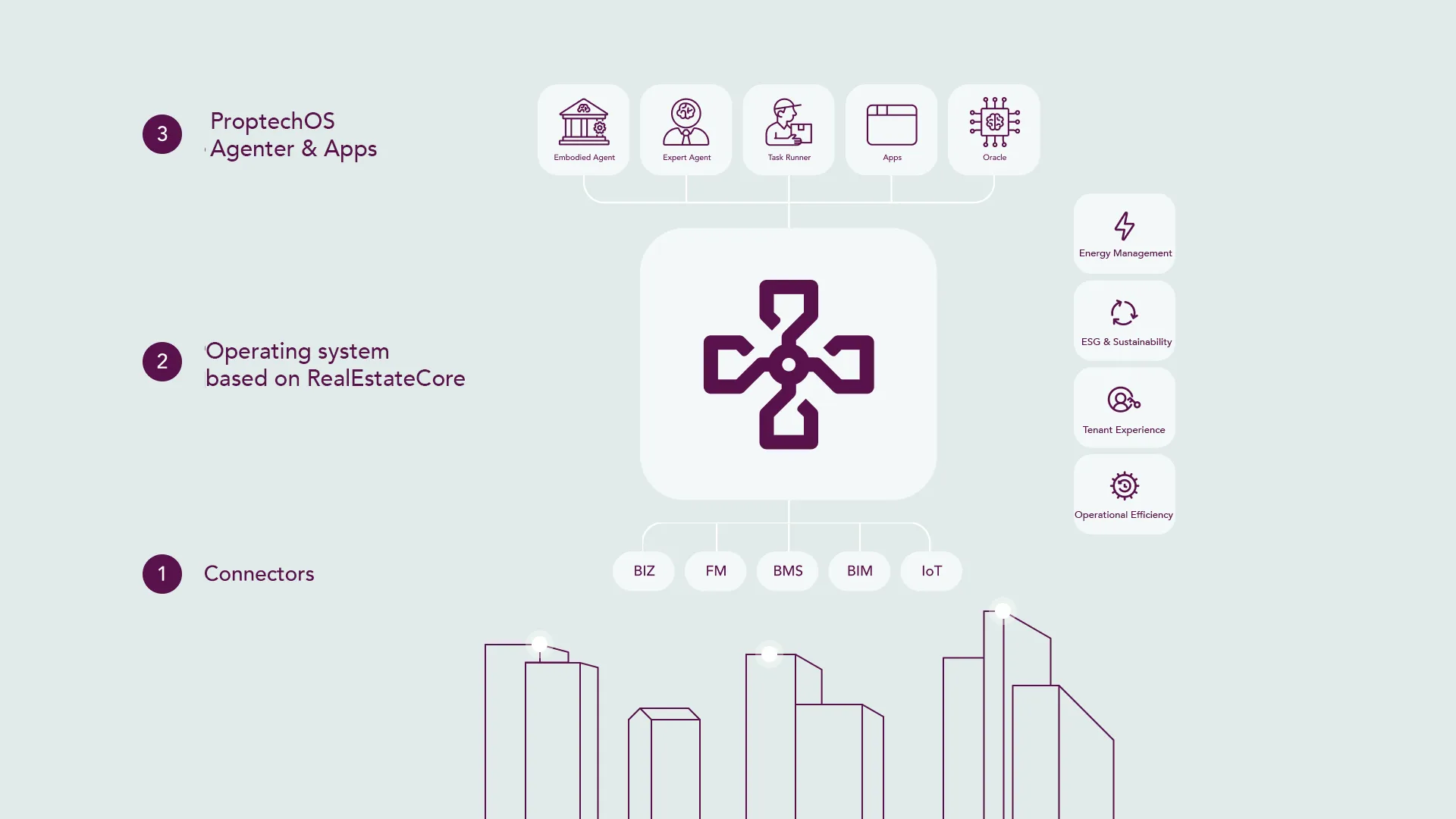
You don’t replace anything. ProptechOS connects to the BMS and IoT systems already deployed across your estate — whatever the vendor — and normalises them onto the open RealEstateCore ontology. That common layer is what turns a fragmented stack into a platform, without a disruptive migration.
It works in three steps. First, connect: we integrate your existing BMS and IoT sources through open interfaces, any vendor. Then normalise: everything is mapped to the open RealEstateCore standard, so your whole estate is described in one consistent model. Then build and act: run AI agents on the platform, expose the data to your own tools through APIs, and extend it however your roadmap demands — all under the governance and guardrails you set.
Open standard. API-first. You own your data. No vendor lock-in.
What changes for your stack
Integration becomes a query against one consistent data model. Data ownership is settled, because the layer is open and portable. And every new capability, from analytics to AI agents, builds on the same AI-ready platform.
Integrations and protocols
ProptechOS includes certified edge connectors for standard industrial and IoT protocols: Modbus TCP/IP, Modbus RTU, OPC UA, MQTT and AMQP. It also has ready-made integrations for major building automation platforms, including Siemens Desigo, Schneider Electric EcoStruxure, Tridium Niagara 4, Sauter, Fidelix, Iconics and WebCTRL.
Beyond the BMS, connectors cover several other source types:
- Metering: Elvaco, EMU
- IoT sensors: Disruptive Technologies, Haltian, Treon
- Energy markets and weather data: Nord Pool, SMHI
- Enterprise and data platforms: Azure SQL, Google BigQuery, Workday, JD Edwards
Edge data enters the platform as RealEstateCore edge messages through Microsoft Azure IoT Hub.
See all connectors →
APIs your team can build on
- REST API: explore and edit the knowledge graph, query telemetry and execute actuations. Access uses OAuth2 tokens from the Microsoft identity platform.
- Streaming API: consume telemetry in real time through Azure Event Hub, with individual keys per user or application.
- Delta stream: subscribe to changes in the digital twin as they happen.
- Edge interface: build your own connectors from a documented interface and sample connector.
API reference (Swagger) · Developer docs · Code examples
Security by architecture
- Infrastructure: built on Microsoft Azure Platform-as-a-Service components. Services that don’t use PaaS run in containers on Azure Kubernetes Service with uniform hardening.
- Encryption: data at rest is encrypted with 256-bit AES. All service-to-service traffic requires TLS 1.2 or higher.
- Edge security: edge nodes connect outbound only, over AMQPS. Every edge message is signed by an authenticated device identity, so no data enters the platform without a traceable source.
- Access control: permissions work on three dimensions. They set which resources a user or app can touch (buildings, spaces, devices), what it can do there (read, write, actuate), and under which role. Users and apps never need blanket access.
- Perimeter: internet-facing endpoints sit behind Cloudflare, which provides DDoS protection.
- Operations: the development team has no access to customer resources. Hardware two-factor authentication is mandatory. All production code is peer-reviewed and cryptographically signed.
