
Your targets are getting harder while your data won’t cooperate
Energy costs keep climbing, and the part that hurts most — peak demand charges — is often the part you can’t see coming. Decarbonisation and net-zero targets land on your desk with real deadlines and no clear operational path to hit them. And when reporting season arrives, the numbers you need for GRESB or environmental, social, and governance (ESG) disclosure are scattered across every building, every meter, and every vendor, so pulling them together is a manual scramble every single time.
Underneath all of it is the same problem: your BMS runs the building on fixed schedules and logs what happened, but it doesn’t optimise against price signals, demand peaks, or carbon intensity — and it certainly doesn’t do it across your whole portfolio at once.
Optimising every building by hand, every hour of the day, is work no energy team has time for.
From logging energy to optimising it
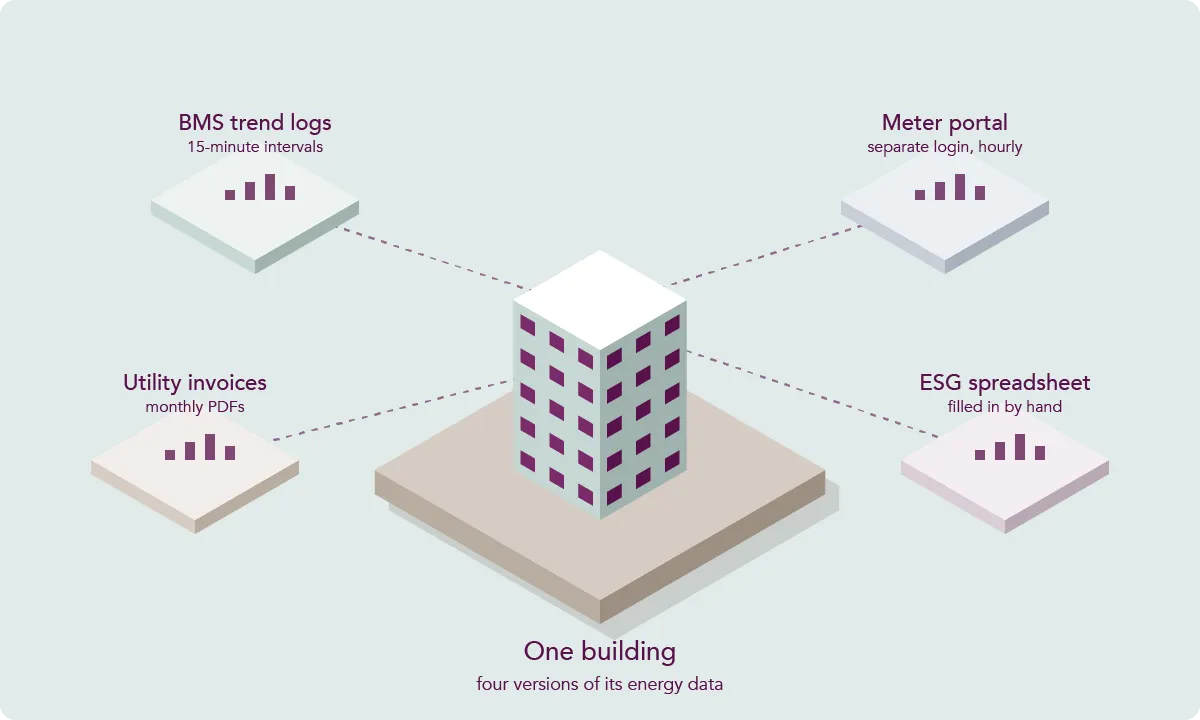
Your BMS is a system of record. It meters consumption and runs the setpoints and schedules it was given — a faithful account of what the building used. What it can’t do is decide, in the moment, how to use less, shift load off a peak, or trade a few degrees of tolerance for a meaningful cut in cost and carbon.
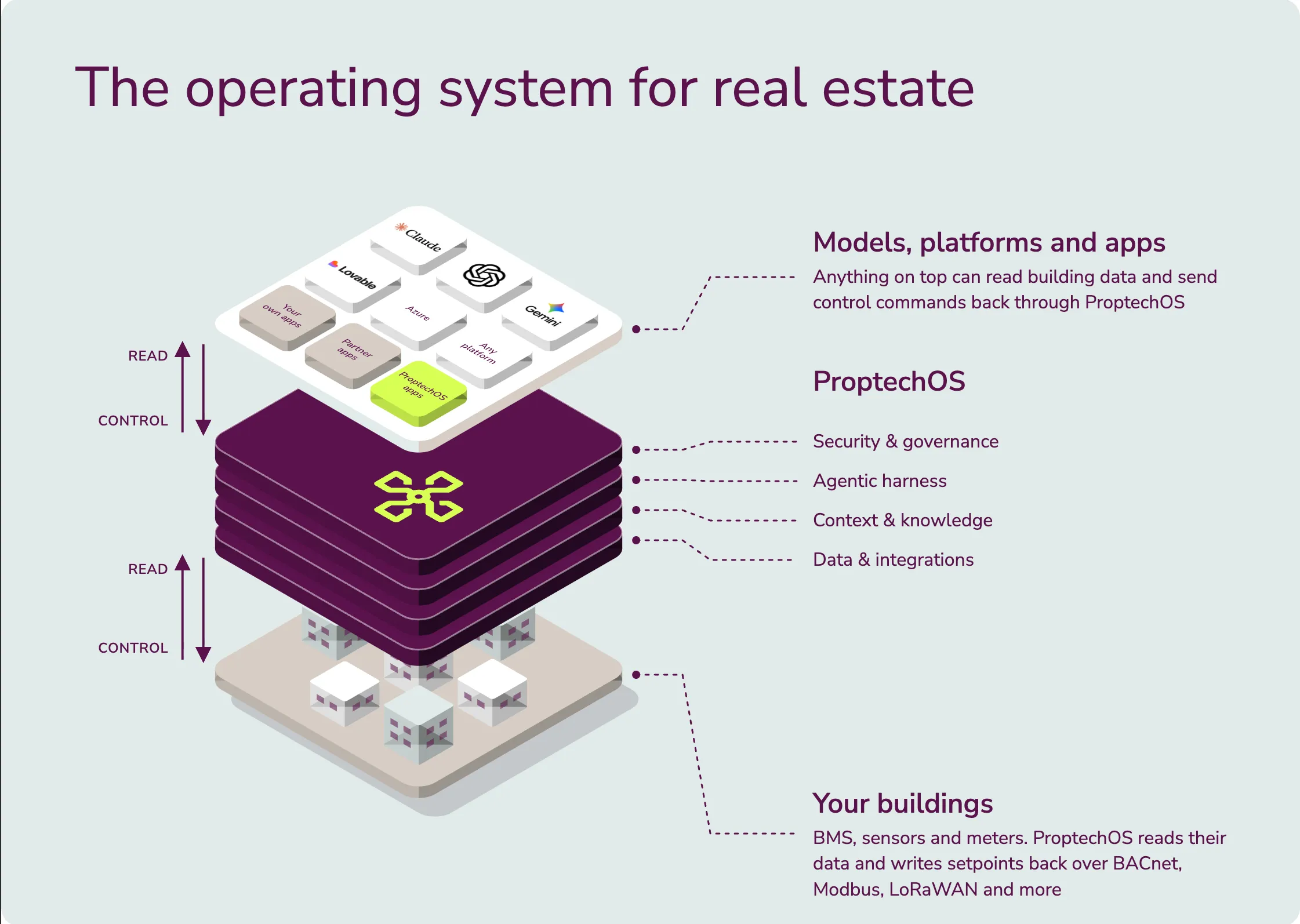
That’s the gap ProptechOS closes. We use the open RealEstateCore standard to normalise data from any BMS, meter, or Internet of Things (IoT) source into one common language, then run AI agents on top of it. The agents act on your consumption continuously, across every building, while your team sets the targets and the limits.
Your meters tell you what you spent. ProptechOS spends less.
Put an agent on the cost and carbon you can’t chase by hand
Each agent is a colleague with one job, and it works on that job every hour of the day.
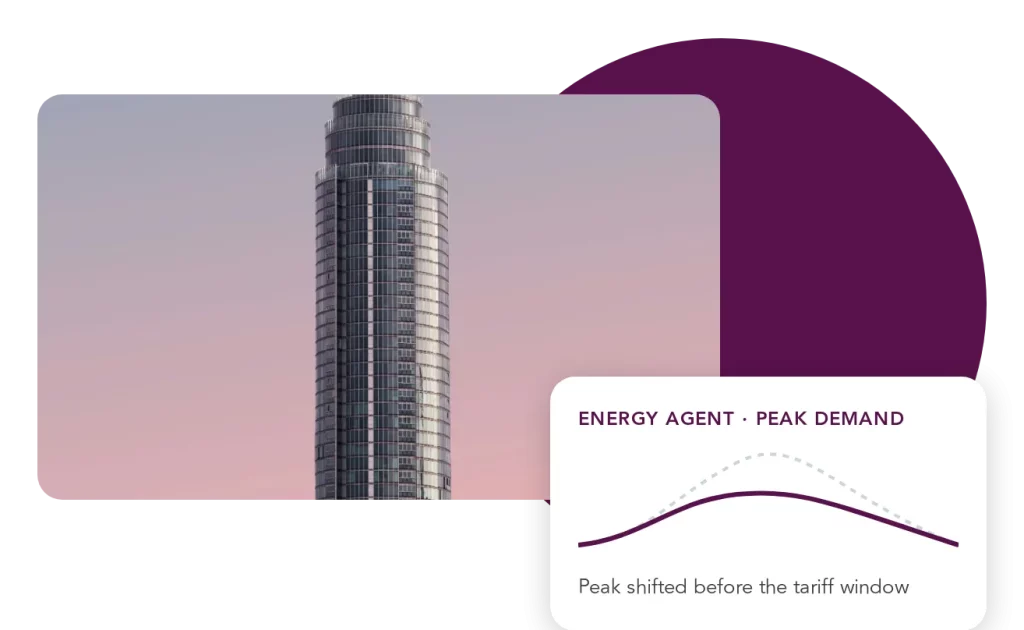
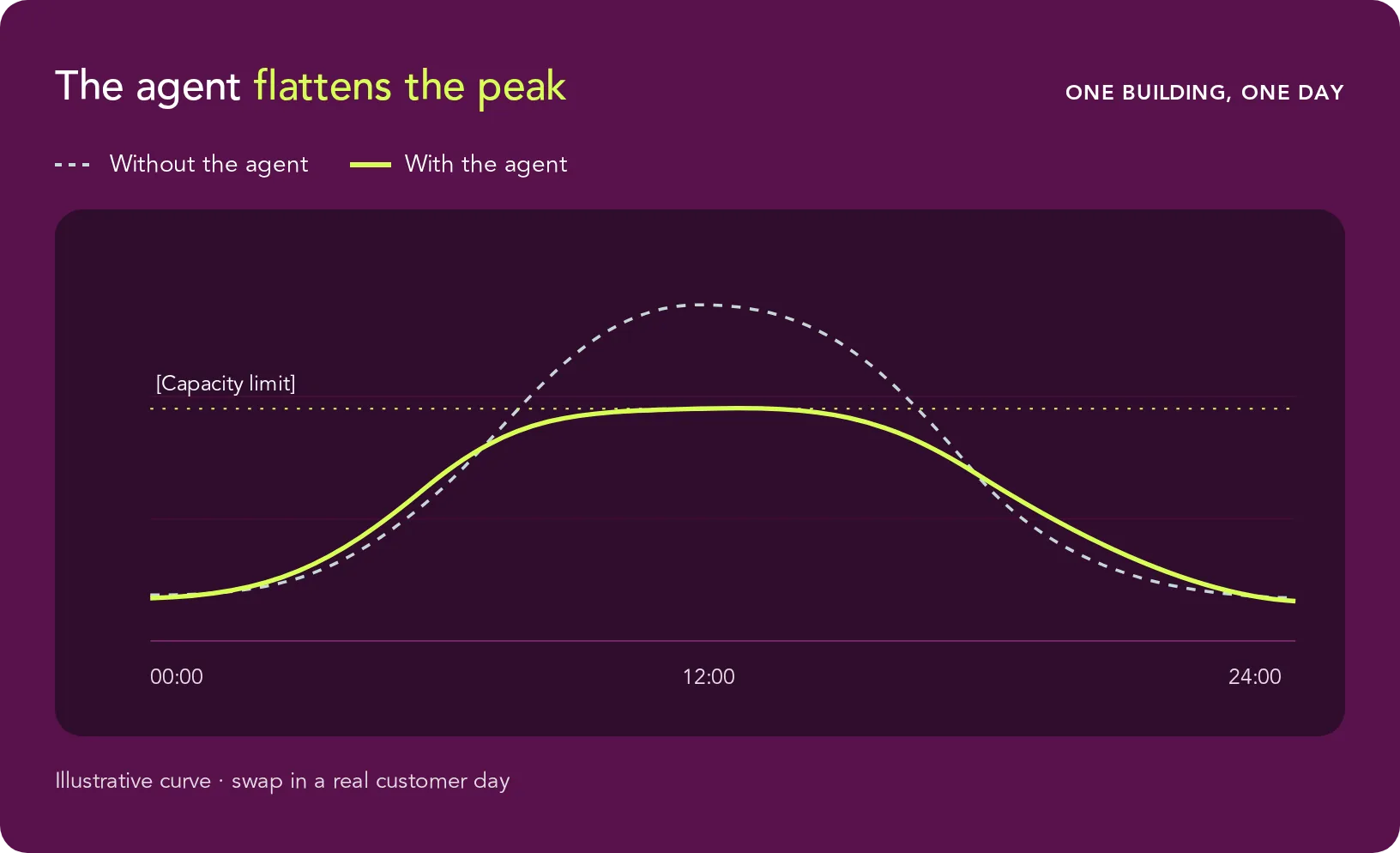
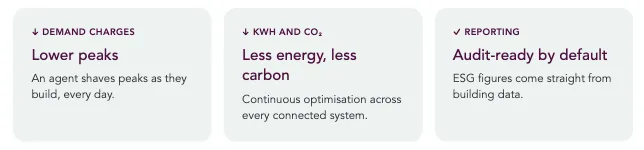
A peak-shaving agent watches demand as it builds and acts before you hit a new peak — pre-cooling, shifting flexible load, and trimming non-critical draw — so you cut the demand charges that quietly inflate the bill.
Energy-optimisation agents continuously tune operation against price, occupancy, and carbon intensity, finding the efficiency that fixed schedules leave on the table without anyone touching a setpoint.
Automated reporting turns live, normalised building data into quality-assured, audit-ready numbers for GRESB, ESG disclosure, and internal targets — so reporting season stops being a scramble and becomes a query.
Agents for your own use cases. When a building has a specific challenge, such as cooling optimisation, you can add a dedicated agent or app that runs on the same normalised data as everything else.
And because everything runs on one normalised layer across the estate, you can benchmark energy and carbon performance building-to-building, spot the worst performers, and put the same agents to work everywhere at once. The same data layer feeds asset valuation and compliance work too, so energy results show up where the rest of the business looks.
No rip and replace. It works on top of your existing BMS.
You don’t replace anything. ProptechOS connects to the BMS, meters, and IoT systems you already run — across every vendor and every building — and normalises them onto the open RealEstateCore ontology. That common layer is what lets agents optimise across a mixed estate that could never be managed as one before.
It works in three steps. First, connect: we integrate your existing BMS, meters, and IoT sources, any vendor and any building. Then normalise: everything is mapped to one open standard, so every building’s energy and carbon data speaks the same language. Then act: AI agents go to work on demand, efficiency, and reporting — under the guardrails and comfort limits you set.
Open standard. You own your data. No vendor lock-in.
What changes for your numbers
Peak demand charges come down because an agent shaves each peak as it builds. Everyday consumption drops as optimisation finds efficiency that fixed setpoints miss. Carbon intensity improves because operation follows the grid in real time. And reporting that used to take weeks of manual collation becomes quality-assured data you can pull on demand.
Proof from Sweden’s largest commercial property owner
Vasakronan owns 168 properties and 2.4 million square metres, with a target of using 50% less energy than the industry average. At Kista Science Tower, its energy team used ProptechOS to cut subscribed district-cooling power by 36%, worth 200,000 SEK (roughly €18,000) a year from a single building.
Subscribed power works like a demand charge: you pay for your peak capacity, so every kilowatt shaved off the peak comes straight off the bill.
The bigger change was in how the work gets done. Operators used to read sensor data building by building. Analysts imported and cleaned data from several systems before any analysis could start. Faulty equipment was only found on occasional site visits. Now the data arrives normalised, the whole portfolio can be checked in minutes, and the impact of every optimisation shows up right away.
Vasakronan’s next target is a 10% cut in subscribed heating and cooling power across most of its Stockholm portfolio, worth an estimated 6 MSEK a year.
Read the Vasakronan case study: https://proptechos.com/case-studies/proptechos-optimize-application-contributes-to-vasakronans-energy-optimization/
