
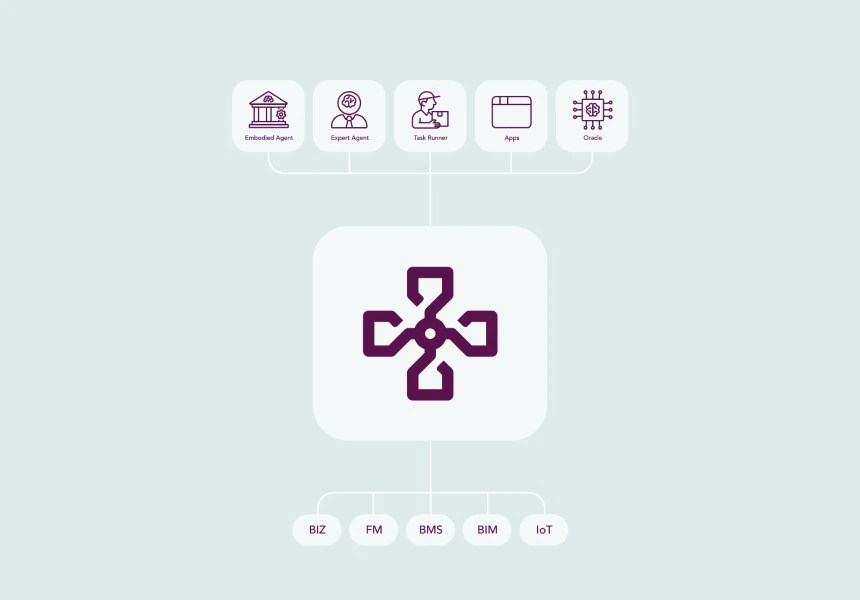
Real estate has always been a data-intensive industry – property values, maintenance schedules, energy consumption, tenant complaints, compliance requirements, and market dynamics all converge into a complex operational picture. Now, AI agents are transforming how property managers, building operators, and real estate firms handle this complexity.
This guide explores how to create AI agents for real estate, drawing on real-world deployments that show what autonomous, multi-agent systems can actually accomplish in property operations – from energy peak shaving to complaint triage.
What is an AI agent for real estate?
An AI agent for real estate is designed to perform a specific operational task. It perceives building or property data, applies logic within a defined scope, and takes action – without requiring human intervention at each step. Unlike a traditional dashboard that shows you what’s happening, an AI agent does something about it.
The key distinction: these are not analytics tools. They act.
In real estate operations, that means an AI agent might:
- Detect an impending energy demand spike and instruct EV chargers to reduce load
- Monitor incoming maintenance tickets and escalate complex ones to specialized analysis
- Triage tenant temperature complaints using historical data and adjacent room sensors
- Adjust HVAC setpoints based on occupancy and schedule data
Each of these is a focused task with a clear trigger, a defined scope, and a measurable output. That is what makes it an agent – a single worker with a specific job.
But real buildings don’t run on isolated tasks. They require coordination. That is where the picture gets more interesting.
From agents to agentic systems: understanding the architecture
When you create AI agents for real estate, one of the first design decisions is whether to deploy a single agent or an orchestrated system of agents. Real-world deployments strongly favor the system approach for complex property environments.
Single-agent systems
A single agent handles one specific task end-to-end. The peak shaving agent described in live ProptechOS deployments is a strong example: it monitors power consumption for a building, identifies when demand peaks are approaching, calculates how much load needs to be shed, and directly instructs building systems – like EV chargers – to reduce their draw.
This agent:
- Analyzed current and predicted power load for the building
- Identified that a demand peak was imminent
- Generated a three-step remediation plan
- Assessed the implications of inaction
- Executed autonomously – instructing EV chargers to reduce load by at least 17 kW over the next hour
No dashboard. No human approval at each step. The agent handled the entire workflow.
Agentic systems: when agents work together
For more complex real estate operations, individual agents are not enough. The real operational value emerges when multiple agents are orchestrated into a coordinated system – each contributing its specialty, sharing context, and handing off work as needed. This is where individual AI agents become part of something larger: an agentic system.
An agentic system is not just a collection of agents. It is an architectural capability – a system that can pursue goals, adapt to changing conditions, and coordinate execution across buildings and workflows with minimal human direction.
There are two primary organizational models:
Collaborative systems have agents working in parallel on different aspects of a problem, sharing information and handing off tasks as needed.
Hierarchical systems use a tiered structure where lightweight agents handle routine monitoring and escalate to more powerful agents when situations require deeper analysis.
The hierarchical model is particularly cost-effective and responsive in real estate contexts because most building events are routine. A small, fast agent can screen the continuous flow of sensor data or service tickets and only invoke a more computationally expensive agent when genuine complexity is detected.
The key difference: a single AI agent executes a task. An agentic system owns an outcome – coordinating multiple agents, evaluating results, and adapting when conditions change.
Why agents are different from traditional building software
Before diving into how to build agents, it’s worth being precise about what an agent actually is – and what it isn’t. Most real estate portfolios already use powerful software with built-in logic that executes tasks and workflows automatically: energy optimisation platforms, BMS automation rules, compliance tools. Those are applications, not agents. And that’s not a criticism – they’re doing exactly what they were designed to do.
What traditional applications do
A traditional building application follows defined, pre-programmed logic. It watches specific data inputs, executes a fixed workflow when conditions are met, and produces a predictable, repeatable output. The rules are set at build time. The application doesn’t reason about what to do – it does what it was told. This is a strength: applications are fast, reliable, and auditable. For well-understood, stable workflows, they are often the right tool.
What makes an agent different
An agent adds a layer of reasoning on top. Rather than following a fixed script, an agent:
- Perceives context across multiple data sources simultaneously
- Reasons about what the situation means and what response is appropriate
- Decides which action to take – including whether to act at all
- Adapts when conditions change in ways that weren’t explicitly pre-programmed
But the real difference goes deeper than that.
Agents come with the world’s knowledge built in. Modern real estate AI agents are built on large language models trained on vast amounts of human knowledge – including deep expertise in energy systems, HVAC, building physics, indoor climate standards, sustainability regulations, and facility operations. That knowledge doesn’t need to be programmed in. It’s already there.
This means an agent can reason about a situation the way a seasoned expert would. If a CO2 spike coincides with a temperature deviation in a meeting room at 8am, the agent doesn’t need a rule that says “this is an occupancy surge before ventilation caught up.” It already understands that pattern – and knows what to do about it.
And you can make them experts in your world. On top of that foundation, you can layer your own domain expertise: your organisation’s operational standards and comfort thresholds, portfolio-specific knowledge about how particular buildings behave, industry frameworks like BREEAM or LEED, and your own historical data patterns – what “normal” actually looks like in your portfolio.
The result is an agent that combines broad intelligence with deep, organisation-specific expertise. That’s a fundamentally different proposition to any application – and something that has simply not been possible in building operations until now.
A simple way to think about it
| Application | Agent | |
| Logic defined | At build time | At runtime |
| Handles edge cases | No | Yes |
| Reasons across systems | Limited | Yes |
| Domain knowledge | Only what’s programmed | Vast + customisable |
| Adapts to new situations | No | Yes |
| Best for | Stable, repeatable workflows | Complex, variable situations |
They work better together
This isn’t an either/or choice. The most effective deployments use both. Applications handle the high-volume, well-defined work reliably in the background. Agents sit on top – watching for situations that fall outside the script, reasoning across systems and context, and deciding how to respond with the expertise of a seasoned operator.
The practical test: If you can fully describe the logic in an IF/THEN statement today, you probably want an application. If the right response depends on context that changes – across buildings, systems, time, and circumstances – you want an agent.
Core agent types to build for real estate
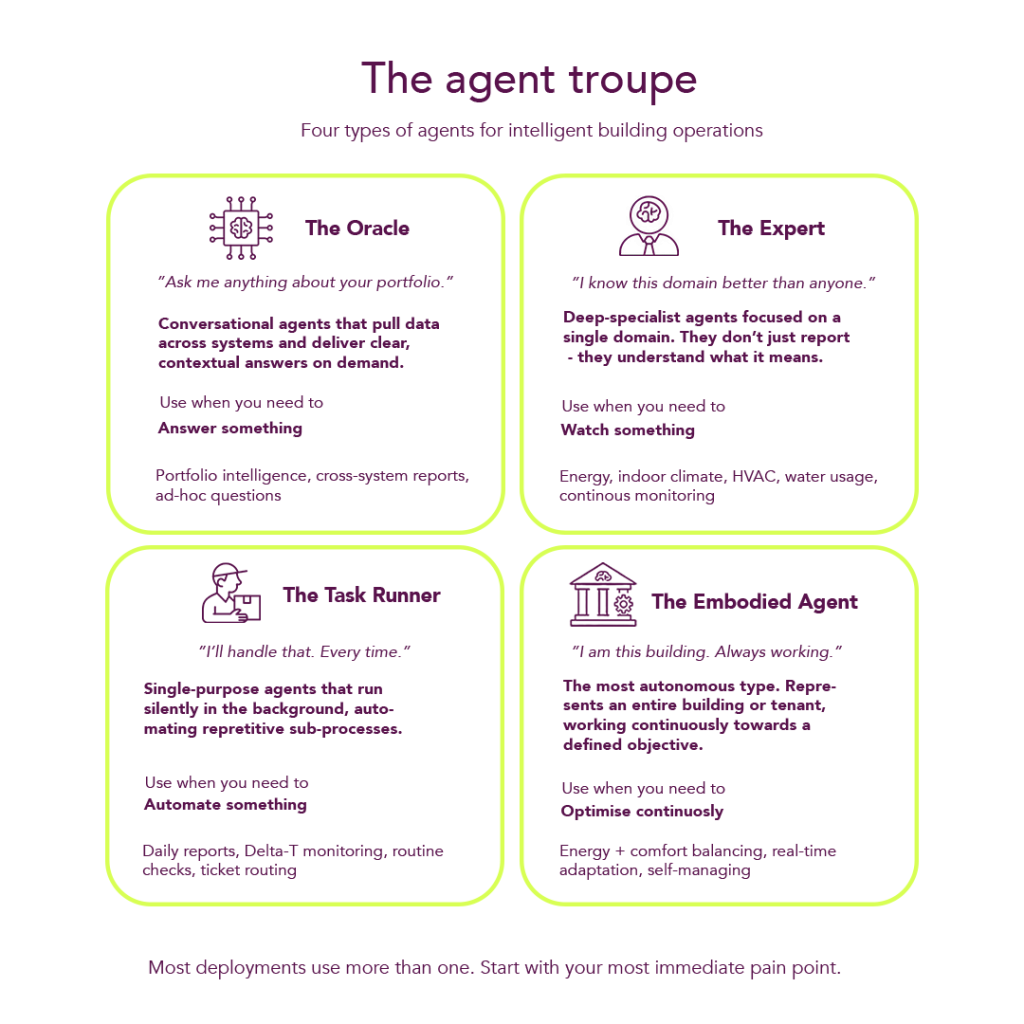
Think of your real estate AI deployment not as a single tool, but as a team of colleagues – each with a defined role, working autonomously or in coordination with others. Four agent archetypes map cleanly onto property operations.
Oracle agents
Oracles are your organization’s knowledge layer. They have access to all building and portfolio data and can instantly synthesize it into answers, dashboards, reports, and presentations on demand. Rather than navigating multiple systems to pull a picture of a building’s energy performance, compliance status, or maintenance history, you ask the oracle and it assembles the answer.
In practice, an oracle agent serves property managers, asset managers, and executives who need fast, reliable answers across a broad data landscape – without becoming data analysts themselves.
Expert agents
Experts go deeper in a specific domain. An energy expert agent doesn’t just report consumption data – it understands efficiency benchmarks, utility tariff structures, demand charge mechanics, and HVAC optimization best practices. An air quality expert understands what sensor readings mean for occupant health and regulatory compliance. A financial expert knows how operational anomalies translate into budget impact.
Each expert agent is empowered with domain knowledge and has a domain-specific goal. When a task runner detects something unusual, it’s the expert that determines what it actually means and what to do about it.
Embodied agents
Embodied agents represent a specific building, system, or even a tenant. They are the closest an individual agent gets to agentic behaviour, because they have persistence and identity – continuously working toward an entity’s objectives rather than waiting to be invoked.
A building agent might balance energy efficiency, occupant comfort, and maintenance cost simultaneously, making small adjustments across connected systems throughout the day. A tenant agent might monitor lease terms, service requests, and satisfaction signals, proactively flagging issues before they escalate.
What distinguishes embodied agents is that they have ongoing responsibilities. They can collaborate with other agents or assist human colleagues as part of a broader workflow. In an agentic system, embodied agents often serve as the persistent layer that ties specialist agents together around a shared objective – like the overall performance of a building.
Task runner agents
Task runners are the workhorses: single-purpose, headless agents dedicated to automating one specific task or subprocess. They run quietly in the background, handling the repetitive monitoring and routing work that would otherwise consume human attention at scale.
A Delta-T task runner watches supply and return temperature differentials across HVAC meters. A complaint monitor watches the inbound ticket queue. A power consumption watcher checks demand against contracted thresholds. None of these agents do complex reasoning – but each knows exactly when to escalate to an expert agent or flag a human. That hand-off is the critical function: filtering the continuous noise of building data so that expert intelligence is applied only where it genuinely matters.
Together, these four types form a complete operational team. Task runners handle the volume. Experts handle the complexity. Oracles handle the questions. Embodied agents represent the persistent interests of the assets and people they serve. Individually, each is an AI agent. Orchestrated together with shared context and coordinated execution, they become an agentic system.
How to create an AI agent for real estate: step-by-step
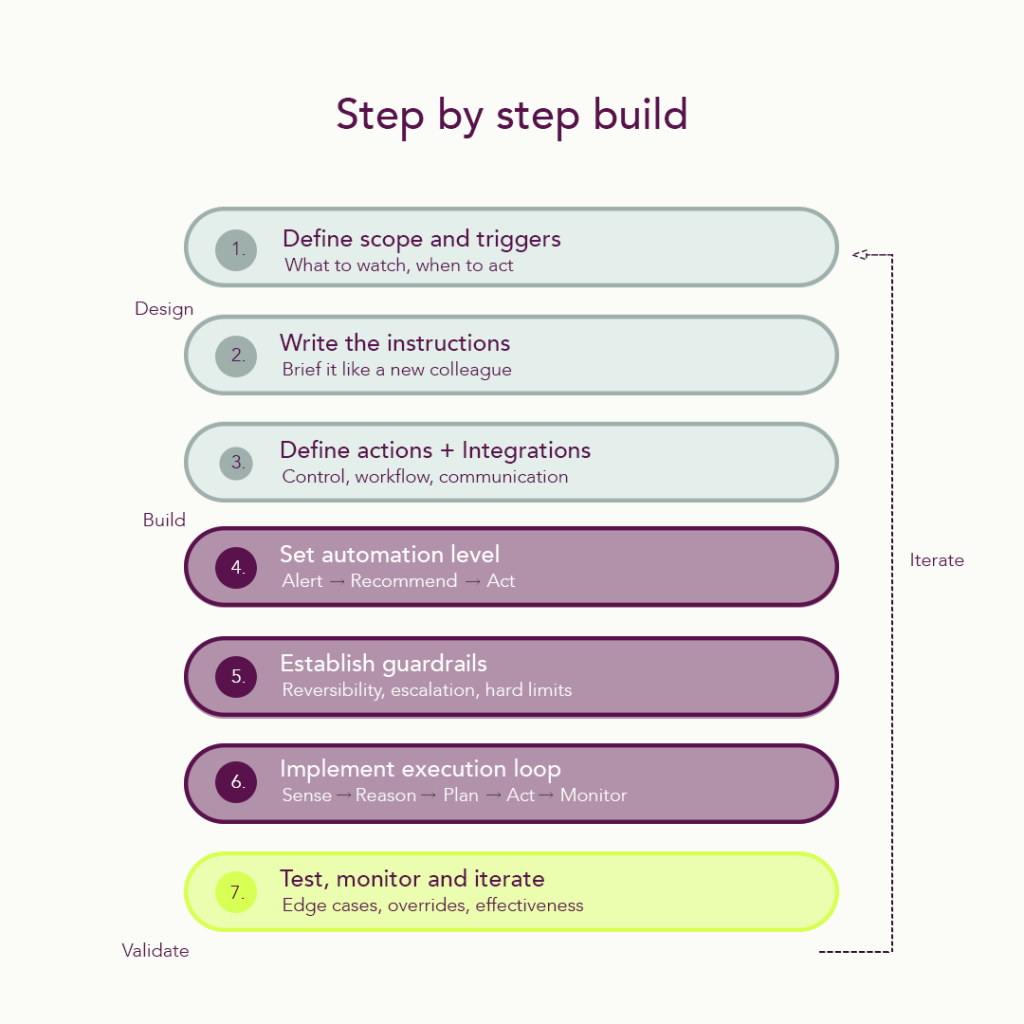
Step 1: Define the agent’s scope and trigger conditions
Every effective real estate AI agent starts with a clear problem definition:
- What data will it monitor?
- Under what conditions should it act?
- What actions can it take?
- When should it escalate to a human?
For a peak shaving agent: monitor real-time power consumption data, trigger when demand approaches 85% of the contracted peak, shed controllable loads in priority order, alert the facilities manager if load shedding is insufficient.
For a complaint triage agent: monitor the ticket queue, trigger when tickets involve HVAC or temperature complaints, retrieve contextual building data, generate a structured brief, assign to the appropriate maintenance team.
Step 2: Write the agent’s instruction
This is where most agents succeed or fail. Think of the agent instruction like a job advertisement – you’re describing a role, not programming a machine. What is the agent responsible for? What does good performance look like? How should it handle the situations it encounters?
A well-written instruction covers four things:
- What to watch – which data, systems, or metrics the agent should monitor
- What matters – the conditions, thresholds, or patterns that should trigger a response
- What to do – how the agent should respond when something is detected
- What to ignore – edge cases, exceptions, or noise the agent should filter out
The golden rule: write it the way you’d brief a smart new colleague on their first day. Give them enough context to use good judgement – not so many rules that they can’t think for themselves.
Step 3: Define agent actions and system integrations
An agent that only analyzes is a sophisticated alert. An agent that can act is where the real value lies. Define which systems your agent can control:
- Direct control: EV charger load management, HVAC setpoint adjustments, lighting schedules
- Workflow triggers: Creating and routing work orders, sending notifications, escalating to human operators
- Communication: Alerting tenants, notifying contractors, reporting to management
Not every agent needs all three categories. A monitoring agent might only trigger notifications. An energy optimisation agent might need direct control over specific systems. Match the action scope to the agent’s purpose.
Step 4: Set the automation level
Decide how much the agent should do on its own. Most platforms support a spectrum:
- Alert only – the agent detects and notifies, a person decides what to do
- Recommend – the agent detects, explains, and suggests an action
- Act – the agent detects and executes the response automatically
Starting at “alert only” or “recommend” is good practice for new agents. Move to full automation once you’ve validated the agent’s behaviour and established trust in its judgement.
This graduated approach matters. The organisations seeing the best results from AI agents don’t start with full autonomy – they earn it, one validated decision at a time.
Step 5: Establish guardrails
Even agents with full automation should operate within defined boundaries. Guardrails protect you from unintended consequences while still giving the agent room to be useful.
Define what the agent can do autonomously versus what requires human approval. For low-risk, reversible actions (reducing EV charger output), full autonomy is appropriate. For high-impact actions (equipment shutdowns, tenant-facing communications), human-in-the-loop confirmation may be warranted.
Key guardrail categories:
- Reversibility – prefer actions the agent can undo or that a person can easily correct
- Escalation triggers – conditions under which the agent should stop acting and hand off to a human
- Hard boundaries – limits the agent is never allowed to exceed, regardless of its reasoning
Step 6: Implement the execution loop
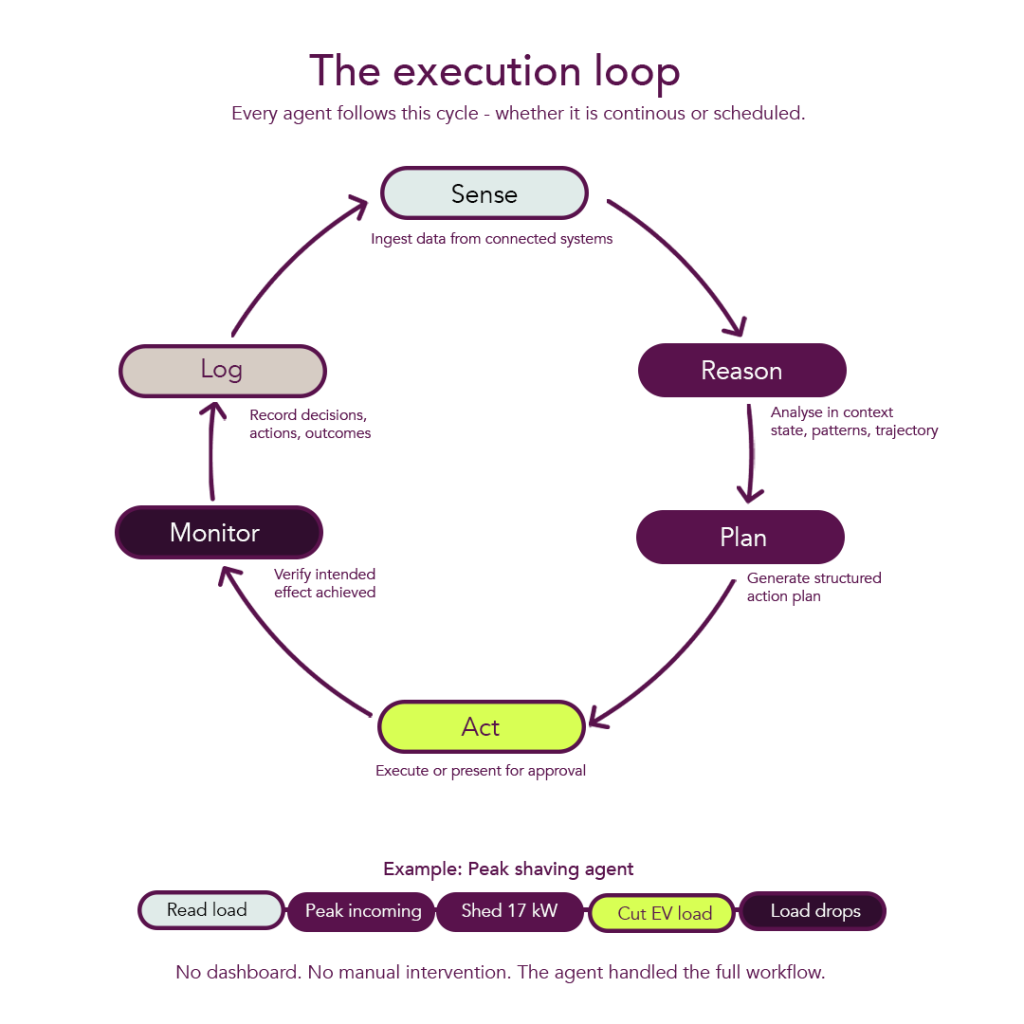
The core execution loop for a real estate AI agent follows the sense-reason-act pattern:
- Sense: Ingest current data from connected systems
- Reason: Analyze the data in context – current state, historical patterns, predicted trajectory, implications of different responses
- Plan: Generate a structured action plan with expected outcomes
- Act: Execute the plan autonomously or present it for human approval
- Monitor: Verify that actions had the intended effect
- Log: Record the decision, actions taken, and outcomes for future learning
For a single agent, this loop runs within a defined scope. In an agentic system, multiple agents run their own loops while a coordination layer manages handoffs, resolves conflicts, and evaluates whether the broader objective is being met. That evaluation and adaptation layer is what makes the system agentic rather than just automated.
Step 7: Test, monitor, and iterate
Real estate AI agents operate in complex physical environments. Rigorous testing before deployment and continuous monitoring after go-live are essential.
Test scenarios should include:
- Edge cases in your trigger conditions
- Actions the agent might take in error
- System integration failures (what happens when a command to a building system fails?)
- Escalation paths when the agent lacks confidence in its analysis
Monitor post-deployment for:
- False positive escalations – task runners triggering unnecessarily
- Missed detections – situations that should have triggered action but didn’t
- Action effectiveness – did the peak shaving actually prevent the demand charge?
- Human override patterns – frequent overrides suggest the agent is miscalibrated
Real-world results: what AI agents are delivering in real estate
The deployments described here – running on the ProptechOS platform – demonstrate what’s possible when AI agents are integrated into building operations:
Energy demand management: Automated peak shaving executed without human involvement, reducing demand charges through proactive load curtailment. The agent not only detected the impending peak and instructed the EV chargers to shed 17 kW – it did so while the facilities team was engaged in other work, without requiring their attention.
HVAC efficiency monitoring: Delta-T analysis running continuously across the building’s thermal distribution systems, automatically escalating inefficiency patterns for expert investigation before they become costly problems.
Complaint intelligence: Tenant complaints transformed from raw text into richly contextualized technical briefs – with historical data, adjacent sensor readings, and preliminary root cause analysis – before a human technician ever opens the ticket.
The common thread: these agents do work that is impossible with traditional software (which can only apply fixed rules to data it was explicitly programmed to handle) and impractical for humans to perform at scale. Individually, each agent delivers value. Combined into an agentic system, they transform how a building operates.
Choosing the right platform to create AI agents for real estate
Not all platforms are equal when it comes to building real estate AI agents. The right choice depends less on the AI model powering the agent and more on the infrastructure underneath it. Five capabilities matter most:
Data model quality. Agents reason over data. If your platform doesn’t structure building data semantically – understanding that a sensor belongs to a room, which belongs to a floor, which shares an air handling unit with four other zones – your agents are working with a flat stream of readings instead of a model of reality. The difference between a useful agent and a noisy one often comes down to this context layer.
System integration depth. An agent that can only read data is a sophisticated alert. The platforms that deliver real value provide deep, bidirectional integration with building systems – BMS, HVAC controls, EV chargers, lighting, work order systems – so agents can act, not just observe.
Orchestration support. Single agents solve single problems. Agentic systems that coordinate multiple agents across a portfolio require an orchestration layer: shared context, managed handoffs, conflict resolution, and the ability to evaluate whether the broader objective is being met.
Governance and auditability. Every agent decision should be traceable – what was detected, what reasoning was applied, what action was taken, and what the outcome was. In regulated environments, this isn’t optional. In any environment, it’s what allows you to trust an agent with increasing autonomy over time.
Domain specificity. General-purpose AI agent frameworks offer flexibility but require significant integration work to connect to building systems and model property contexts. Real estate-specific platforms like ProptechOS provide the semantic data layer, building system integrations, and operational workflows that general frameworks leave you to build yourself.
Key considerations when building real estate AI agents
Data access and quality: Agents are only as good as their data. Invest in clean, reliable, real-time data pipelines before worrying about agent intelligence.
Action safety and reversibility: Prefer agents that take reversible actions and escalate when uncertain. An agent that reduces EV charger output can be corrected easily. An agent that miscommunicates with tenants creates real problems.
Explainability: Property managers and building owners need to understand why the agent did what it did. Build agents that generate human-readable logs of their reasoning and actions.
Regulatory compliance: In some markets, automated building control systems are subject to energy, safety, and building code regulations. Confirm compliance requirements before deploying agents with direct system control.
Integration complexity: Real estate operations touch many software systems – BMS, CMMS, property management, accounting. Each integration point is a potential failure mode. Plan for graceful degradation when integrations fail.
The future: from agents to agentic operations
The direction is clear: more autonomous, more collaborative, and more capable.
Today’s deployments demonstrate meaningful value with individual AI agents handling energy management, maintenance operations, and tenant experience. As foundation models improve and building data infrastructure matures, these agents will increasingly operate as coordinated agentic systems – pursuing portfolio-level objectives, adapting to changing conditions, and continuously improving through feedback.
The buildings and portfolios that invest now in the data infrastructure, integration architecture, and agent development are positioning themselves for a substantial operational advantage. The peak shaving agent that eliminated the demand charge without anyone needing to be in the loop isn’t a prototype – it’s working in production today. The agentic system that coordinates dozens of such agents across an entire portfolio is the next step.
Summary
The real estate industry is moving from reactive maintenance and manual optimization to proactive, autonomous building operations. AI agents are the building blocks of that shift – individual tools that sense, reason, and act within defined scopes. Orchestrated into agentic systems, they become something greater: a coordinated operational layer that owns outcomes, not just tasks.
The distinction matters. Start with agents. Build toward agentic.

