
Smart ventilation analysis delivers 30% energy reduction at Oslo’s Eufemia building
Case Study
Advanced building analytics revealed extensive energy savings in KLP Eiendom’s premium Eufemia building, leading to a 31% reduction in unnecessary ventilation, from annually 262 million to 180 million cubic meters of air being processed during off-hours.
About Eufemia
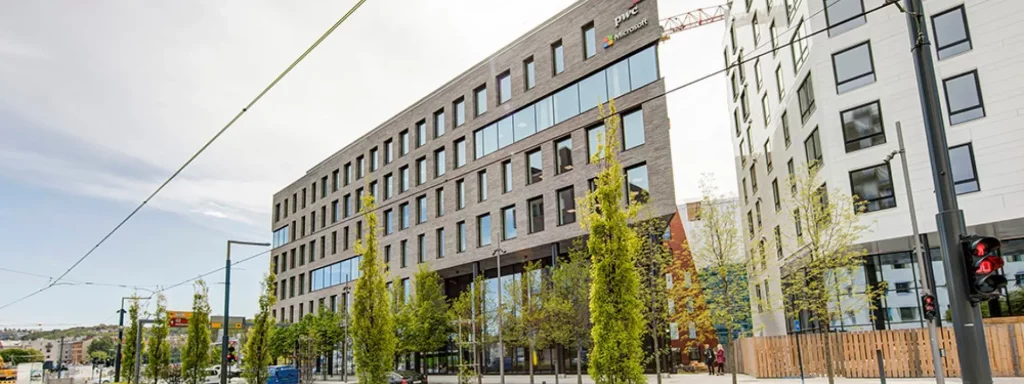
In Oslo’s dynamic Bjørvika district stands the Eufemia building. A modern eight-story office complex owned by KLP Eiendom, one of the Nordic region’s largest real estate companies. This BREEAM-NOR Excellent certified building houses major tenants including Microsoft and PwC across its 22,400 square meters.
Despite its green credentials and proper initial installation, the building presented an opportunity for optimization: ventilation systems were operating on traditional fixed schedules during nights and weekends when offices had minimal occupancy.
“The Eufemia project clearly shows how data-driven insights can unlock hidden potential in even the most advanced buildings. By reactivating existing smart systems, we achieved substantial energy savings without any new investments — a win for both sustainability and operational efficiency.”
Technical Manager
Conclusion
The hidden configuration issue
The Eufemia building’s ventilation system is equipped with demand-controlled ventilation capabilities, a standard feature designed to prevent over-ventilation and optimize energy use. However, these optimization features were not functioning as intended, causing the system to process 1.6 million cubic meters of air per week during off-peak hours, totaling approximately 82 million cubic meters annually when the building had minimal occupancy.
This type of configuration issue is surprisingly common in modern commercial buildings. While the technology exists within the systems, improper setup or gradual system drift can cause efficiency features to become inactive, and these problems are notoriously difficult for property owners to detect without specialized monitoring and analysis tools.
Solution
AI-powered detection and resolution
ProptechOS’s AI-based analytics quickly identified what had been an elusive problem for the property management team. Through continuous monitoring and intelligent analysis, the system detected that the demand-controlled ventilation features were not operating correctly.
The analysis revealed:
- Built-in optimization features were inactive or improperly configured
- Ventilation systems were defaulting to maximum air exchange rates regardless of occupancy
- Standard building management dashboards had not flagged the inefficiency
Swift resolution: Once identified, the fix was straightforward—reactivating and properly configuring the existing demand-controlled ventilation features that were already built into the system. No new hardware was required, just correction of the control algorithms and settings that should have been working from the start.
Simple fix, major impact
The beauty of this optimization lies in its simplicity. The building already possessed all the necessary technology for efficient operation, the demand-controlled ventilation features simply needed to be properly activated and configured.
The resolution process:
- ProptechOS’s AI system detected the configuration issue
- Existing demand-controlled ventilation features were reactivated
- Control algorithms were properly calibrated for occupancy-based operation
- Systems were configured to maintain optimal air quality while reducing unnecessary air processing
This demonstrates a critical insight for property owners: sophisticated building systems often contain efficiency features that may not be working as intended, and these issues can persist undetected without proper monitoring and analysis.
Reduction in off-peak ventilation
Annual energy savings
Annual cost savings
Result
Remarkable results
Following implementation, Eufemia achieved:
- 31% reduction in off-peak air processing: From 5 million to 3.5 million cubic meters per week (annual reduction from 262 million to 180 million cubic meters)
- Maintained air quality: Optimal indoor environment for occupant comfort
- Substantial energy savings: The 82 million cubic meter annual reduction translates to significant energy savings across three key areas:
- Fan electricity: Reduced power consumption from ventilation fans operating at lower speeds and frequencies
- Heating energy: Less outdoor air requiring heating during cold months (major factor in Norwegian climate)
- Cooling energy: Reduced cooling load from conditioned air during warmer periods
Energy savings calculation:
The savings derive from specifically the off-peak hours (19:30-05:30 weekdays plus full weekends – representing 58% of total hours). Using Norwegian climate data and the actual electricity, district cooling and heating consumption the following savings are calculated:
- Electric fans: ~46,000 kWh/yr → 2.3% of site electricity
- District heating (thermal): ~164,000 kWh/yr → 12.7% of district heating
- District cooling (thermal): ~62,000 kWh/yr → 12.2% of district cooling
- Total site energy: ~292,000 kWh/yr → ~7.5% of total energy
Total estimated annual energy savings:
292,000 kWh – representing approximately 7.5% of the building’s total energy consumption. At typical Norwegian electricity rates (€0.20/kWh), this translates to approximately €60,000 in annual cost savings.
Critical insight:
This excessive energy waste was completely invisible during normal business hours, when the system operated correctly. The 292,000 kWh annual savings came entirely from the 58% of time when the building should have had minimal ventilation – nights and weekends – making a most significant “hidden” inefficiency.
Broader impact
Financial value:
Buildings can see value increases of 8.5% to 26% from energy performance improvements, with rent premiums rising 2.7% to 9%.
Environmental impact:
Buildings account for 40% of global CO2 emissions. This optimization meaningfully contributes to sustainability goals.
Market advantage:
Energy-optimized buildings remain competitive as costs rise and regulations tighten.
Key takeaways
The Eufemia success demonstrates critical principles for commercial real estate:
Modern buildings often contain sophisticated efficiency features that may be inactive or misconfigured, creating massive energy waste that’s virtually impossible to detect during normal business hours when systems appear to be functioning correctly.
- Smart technology enables precision that scheduled systems cannot achieve
- Data-driven optimization delivers ongoing returns through reduced costs and improved performance
- Sustainability initiatives align with financial returns
Conclusion
Eufemia’s transformation from energy waste to efficiency excellence shows the tremendous potential within our built environment. Through intelligent analysis, KLP Eiendom achieved 31% reduction in unnecessary air processing while maintaining optimal tenant conditions.
This case study provides a blueprint for property owners worldwide: the tools for significant energy savings already exist. The question isn’t whether to optimize, but how quickly to implement solutions that drive both profitability and sustainability.

Ready to discover hidden energy savings in your portfolio?
Advanced building analytics can transform your properties’ performance and profitability.