From spreadsheets to autonomous building intelligence
Most property teams still run on Excel. Exports from BMS systems. PowerBI dashboards built by someone who’s left the company. It works — until it doesn’t scale, runs only during office hours, and misses what happens at 2 AM.
This session of the Agentic Proptech Webinar Series shows what comes next: AI agents that run continuously, reason over live building data, and act — or ask a human to approve the action first.
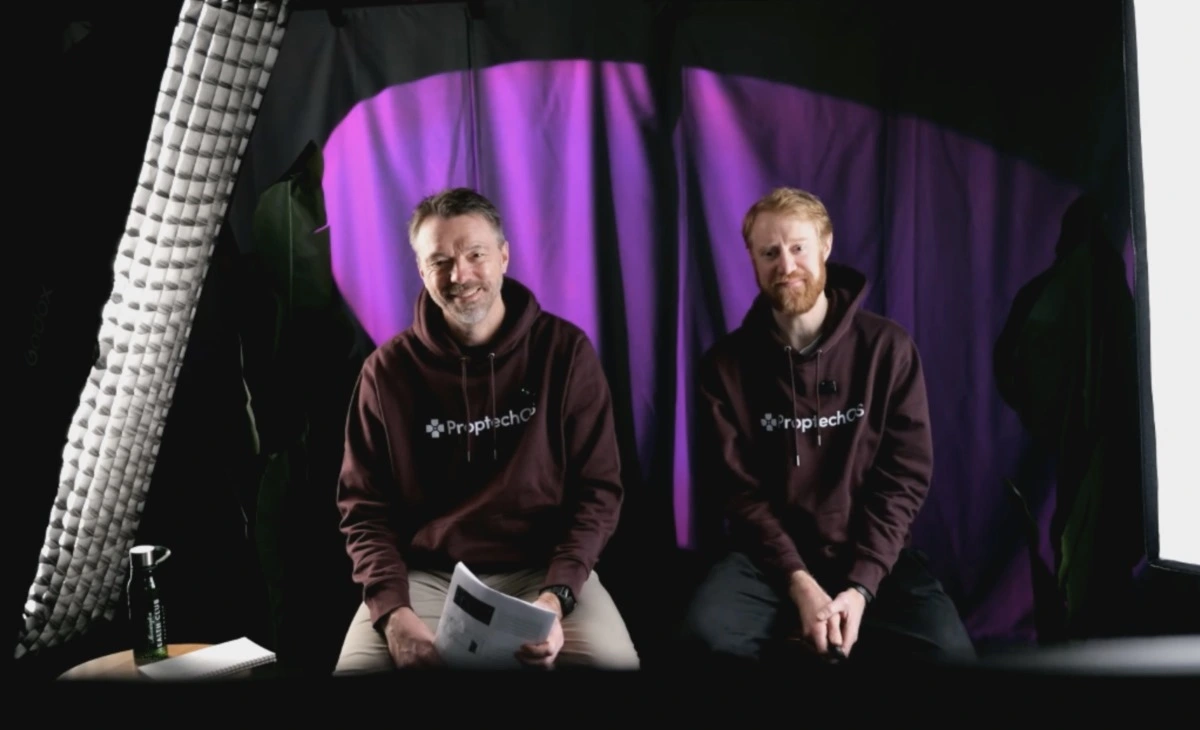
In 45 minutes, Dr. Erik Wallin (Chief Ecosystem Officer, ProptechOS) and Rasmus Gorm Pedersen (Managing Director Denmark) walk through a live demo of a peak-shaving energy agent, explain how multi-agent teams are structured, and share six months of real-world experience running agents on live buildings.
What this session covers
- Why AI agents are different from BMS alarms — agents reason over context, history, and forecasts; BMS rules just fire thresholds
- How multi-agent teams work — one agent detects a problem, another holds the actuator permissions, a human approves the change
- Live peak-shaving demo — a ProptechOS agent detects grid demand approaching 480 kW, throttles EV chargers, and then proposes a corridor heating reduction from 21°C to 17°C for a projected 12–18 kW saving
- Human-in-the-loop workflows — how to run agents in review mode first, build trust, then extend permissions
- How to start — use-case-first vs. IoT-inventory-first approaches, and why the data you think you have is often different from what you actually have
- Real results — 30% reduction in ventilation airflow waste found after moving from manual Excel monitoring to agentic 24/7 surveillance
AI agent use cases demonstrated in this webinar
Energy peak shaving An expert agent continuously monitors electricity consumption across a building. When demand approaches a threshold, it executes a layered strategy: throttle EV chargers first, then reduce heating in unoccupied zones (corridors, garages, hallways). The agent sends a human-readable proposal with expected kW reduction before any actuation occurs.
Water leak detection A portfolio-level monitoring agent scans water meter data across all buildings. When consumption patterns indicate a possible leak, it triggers an alert and — depending on severity — either creates a work order for office hours or escalates to emergency response.
HVAC nighttime schedule optimization An agent detects that ventilation is running at full capacity during unoccupied hours. It analyzes occupancy sensor data, proposes a revised operational schedule, and flags the saving for human review.
Hospital humidity control In operating rooms, humidity levels are life-critical. A ProptechOS agent forecasts when seasonal conditions will push humidity into dangerous ranges and pre-emptively increases ventilation — two hours earlier than a rule-based BMS would trigger — avoiding both health risk and energy waste.
How ProptechOS AI agents are structured
ProptechOS agents run on the RealEstateCore ontology — an open standard that gives every sensor, space, and system across your portfolio a shared data language. This means an agent deployed on one building can scale to hundreds without reconfiguration.
Each agent has three core components:
- A system prompt — the agent’s job description: what it monitors, what decisions it can make, and what it must escalate
- Permissions — explicit definition of what the agent is allowed to actuate. A load-monitoring agent can read all energy data but has zero write access; only the embedded building agent holds actuator permissions
- Audit trail — every action, proposal, and human decision is logged with a timestamp, giving you full operational history and the ability to refine agent behavior over time
“It’s like onboarding a new employee. You don’t give them the keys to everything on day one. They earn trust, take on more responsibility, and you stay in control.” — Dr. Erik Wallin, Chief Ecosystem Officer
What’s already running in production
- 42 open-source agents available in the ProptechOS Agency, covering monitoring, diagnostics, and actuation
- 23% of property management processes now have a defined agent — up from near zero six months ago
- 2,500+ buildings already onboarded with RealEstateCore, making agent deployment fast and scalable
- 1,000 buildings onboarded in one week (13,000 sensors) using ProptechOS onboarding agents
- 6 months of live agent operation on commercial buildings, hospitals, shopping malls, and cold-storage facilities
Frequently asked questions
Q: Why not just use a BMS alarm with a threshold? A BMS alarm fires when a value crosses a fixed threshold. An AI agent reasons: it looks at historical patterns, weather forecasts, occupancy data, and energy pricing together. It can foresee a problem before the threshold is reached, propose a proportional response, and escalate through layers of action rather than just firing a single alert.
Q: What data do I need to get started? At minimum: your BMS system (any brand — Siemens, Schneider, Johnson Controls, or older PLCs via an edge device), electricity meters, and weather forecast access. For peak shaving specifically, energy pricing data (e.g., Nord Pool) and EV charger telemetry add significant value. ProptechOS connects via standard APIs, MQTT, cloud integrations, or direct edge hardware.
Q: How do agent permissions work? Each agent is assigned explicit read and/or write permissions scoped to specific systems and buildings. A monitoring agent can read all sensor data but cannot write any set points. Actuation always requires a separate embedded building agent with scoped permissions — and during onboarding, a human-in-the-loop approval step is standard.
Q: Is my data safe if agents are making decisions? Agents operate within strict permission boundaries. They cannot communicate with agents or systems outside their defined scope. Every proposal, approval, and actuation is logged in a full audit trail. The architecture is designed around the principle that agents are digital employees — governed, permissioned, and auditable.
Q: How long does it take to deploy an agent? The discovery phase — matching your available data against use cases — typically takes a few weeks. Once your buildings are onboarded to RealEstateCore, deploying and testing a new agent can happen in days. ProptechOS has onboarded 1,000 buildings with 13,000 sensors in a single week.
Q: Can I start with agents in read-only / review mode? Yes — and this is the recommended approach. Run the agent for one to two weeks in review mode. Each morning, you’ll see the proposals it would have made. Once you trust the reasoning, you expand its permissions to act autonomously.
See AI Agents running in your buildings
Book a demo and we can see how you can benefit from AI Agents in your portfolio.
Don’t miss our upcoming webinars in the series, sign up here.